Berlin
Tree Root Removal in Berlin, MA 01503.
Learn more →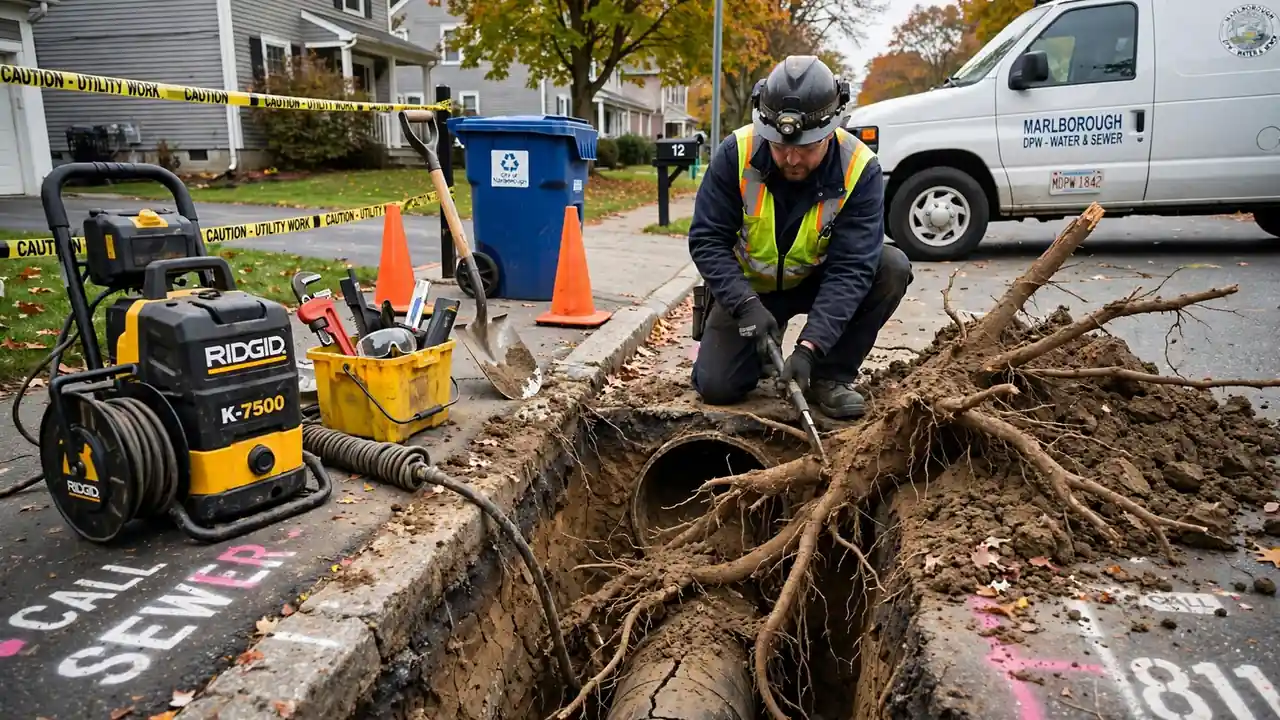
Marlborough, MA tree root removal
Tree root removal clears root masses from sewer laterals with mechanical cutting — then addresses the entry points with lining or repair so the roots do not simply grow back on schedule.
IN SHORT
Tree root removal clears root masses from sewer laterals with mechanical cutting — then addresses the entry points with lining or repair so the roots do not simply grow back on schedule.
Trees do not attack sewer pipes out of malice; they follow water, and a clay lateral with a hairline joint separation leaks exactly enough vapor to announce itself. A root hair enters, finds nutrients, and thickens year after year into a mass that snags everything the household sends down. By the time drains slow, the root ball inside the pipe can be startling — a dense, fibrous plug woven through the joint that started it all. Removal is straightforward. Keeping them out afterward is the actual project.
Mechanical cutting is the removal method that works. A rotating cable with a root-cutting head — blades or chain attachments sized to the pipe — shreds the mass and pulls it back, restoring full bore in the visit. It is fast, effective, and honest about its limits: cutting removes the roots inside the pipe but does nothing to the joint they entered through. That joint is still separated, still leaking vapor, still inviting the next generation. Every honest root-removal visit ends with this conversation.
The permanent answers address the entry. Pipe lining seals every joint along the run with a continuous epoxy barrier — roots cannot penetrate cured resin, and the separated joints cease to matter. Spot repair replaces the failed section where intrusion is localized. Pipe bursting installs a jointless replacement where the whole run is compromised. The camera inspection after cutting shows which answer fits: isolated entries versus joints failed along the run.
Chemical root killers deserve a frank note. Copper sulfate and foaming herbicides can suppress regrowth temporarily, but they do not repair joints, they risk harming the tree and surrounding plantings, and they add chemicals to a system that drains to treatment. Mechanical removal plus a structural fix is the approach that actually ends the cycle; chemicals are a delaying tactic with side effects.
In Marlborough, root work follows the trees. The farmhouse belt — Bolton, Stow, Chapinville — pairs the oldest clay laterals with the most mature maples and oaks: the highest root pressure in the service area. Older neighborhoods in Hudson, Maynard, and French Hill add street trees over clay and cast-iron joints. Wherever clay joints and mature roots coexist, root management is a permanent line item — cutting on interval, lining for permanence.
Warning signs
Common causes
How it works
Equipment
Safety
Cutting heads are operated with the cable properly secured — a bound cutter in a root mass is handled with technique, not force.
We do not recommend chemical root killers as a primary strategy; mechanical removal plus structural repair ends the cycle without chemical side effects.
If cutting reveals a collapsed or severely offset joint, work stops for assessment — forcing equipment through structural failure causes damage.
Disinfection of the work area follows any sewage exposure during the visit.
Local knowledge
The farmhouse belt owns the region's root problem. Bolton, Stow, and the Chapinville area combine 18th- and 19th-century clay laterals with mature sugar maples and oaks whose roots have had a century to explore. On these properties, root cutting is seasonal maintenance the way mowing is — and lining the joints is the permanent upgrade that the camera usually recommends after the second or third cutting.
Orchard country adds a variant: Stow's apple-orchard landscape means laterals running under old orchard rows, where root systems are dense and the soil is worked. Trenchless fixes matter doubly here — open excavation through productive ground and old stone walls is destructive in ways that go beyond the plumbing bill.
Street-tree neighborhoods — French Hill, Hudson's older streets, Maynard's mill blocks — put municipal and private trees over clay laterals along the frontage. The lateral's street-side half is often the worst section, and the repair plan has to account for working near the public right-of-way.
Service area
Tree Root Removal in Berlin, MA 01503.
Learn more →Tree Root Removal in Bolton, MA 01740.
Learn more →Tree Root Removal in Boxborough, MA 01719.
Learn more →Tree Root Removal in Carisbrook, MA 01752.
Learn more →Tree Root Removal in Chapinville, MA 01532.
Learn more →Tree Root Removal in Downtown Marlborough, MA 01752.
Learn more →Tree Root Removal in Fort Meadow, MA 01752.
Learn more →Tree Root Removal in Framingham, MA 01701.
Learn more →Tree Root Removal in French Hill, MA 01752.
Learn more →Tree Root Removal in Hopkinton, MA 01748.
Learn more →Tree Root Removal in Hudson, MA 01749.
Learn more →Tree Root Removal in Indian Head, MA 01752.
Learn more →Tree Root Removal in Lake Williams, MA 01752.
Learn more →Tree Root Removal in Maynard, MA 01754.
Learn more →Tree Root Removal in Nobscot, MA 01701.
Learn more →Tree Root Removal in Northborough, MA 01532.
Learn more →Tree Root Removal in Robin Hill, MA 01752.
Learn more →Tree Root Removal in Southborough, MA 01772.
Learn more →Tree Root Removal in Stow, MA 01775.
Learn more →Tree Root Removal in Sudbury, MA 01776.
Learn more →Tree Root Removal in West Village, MA 01752.
Learn more →Tree Root Removal in Westborough, MA 01581.
Learn more →Yes — cutting removes the mass, not the entry. Regrowth on a one- to two-year cycle is typical. The permanent fix seals the entries: lining the joints shut, spot-repairing failed sections, or bursting a compromised run. We will show you the entry points on camera and lay out both paths — management by cutting, or permanence by sealing. Call (833) 713-2101 for the inspection that decides.
Mechanical cutting inside the pipe does not harm the tree — it only removes the roots that entered the lateral. The tree keeps its structural root system. Chemical treatments are the risk to plantings, which is one reason we favor mechanical removal plus structural repair.
The pattern is distinctive: drains that slow progressively, worst in spring, recurring at regular intervals after previous clearings — and definitive on camera, where root masses show as pale fibrous intrusions at joints. If you have mature trees and clay pipe, roots are the prime suspect until the camera says otherwise.
Temporarily, at best — and with downsides. They suppress regrowth without repairing the entry joints, they can harm desirable plantings, and they add chemicals to the wastewater stream. Mechanical cutting plus lining or repair ends the cycle; chemicals postpone it.
Fast-growing, water-seeking species — maples, willows, oaks, elms — with mature specimens posing the most pressure. But any large tree near a clay lateral is a candidate; the pipe's joints matter more than the species. The camera shows what your specific combination has produced.
Rarely necessary and often regretted. The pipe is the problem — its joints admit roots. Sealing the joints (lining) or replacing the run (bursting) solves the intrusion while keeping the tree. Remove the tree only if it threatens the structure in other ways; fix the pipe for the pipe's problem.
The camera decides: isolated entries get spot repair or sectional lining; joints compromised along the run get full lining or bursting. We mark every entry by distance so the scope matches the evidence — no more, no less.
Call (833) 713-2101 for tree root removal with camera-verified diagnosis.