Berlin
Sewer Leak Detection in Berlin, MA 01503.
Learn more →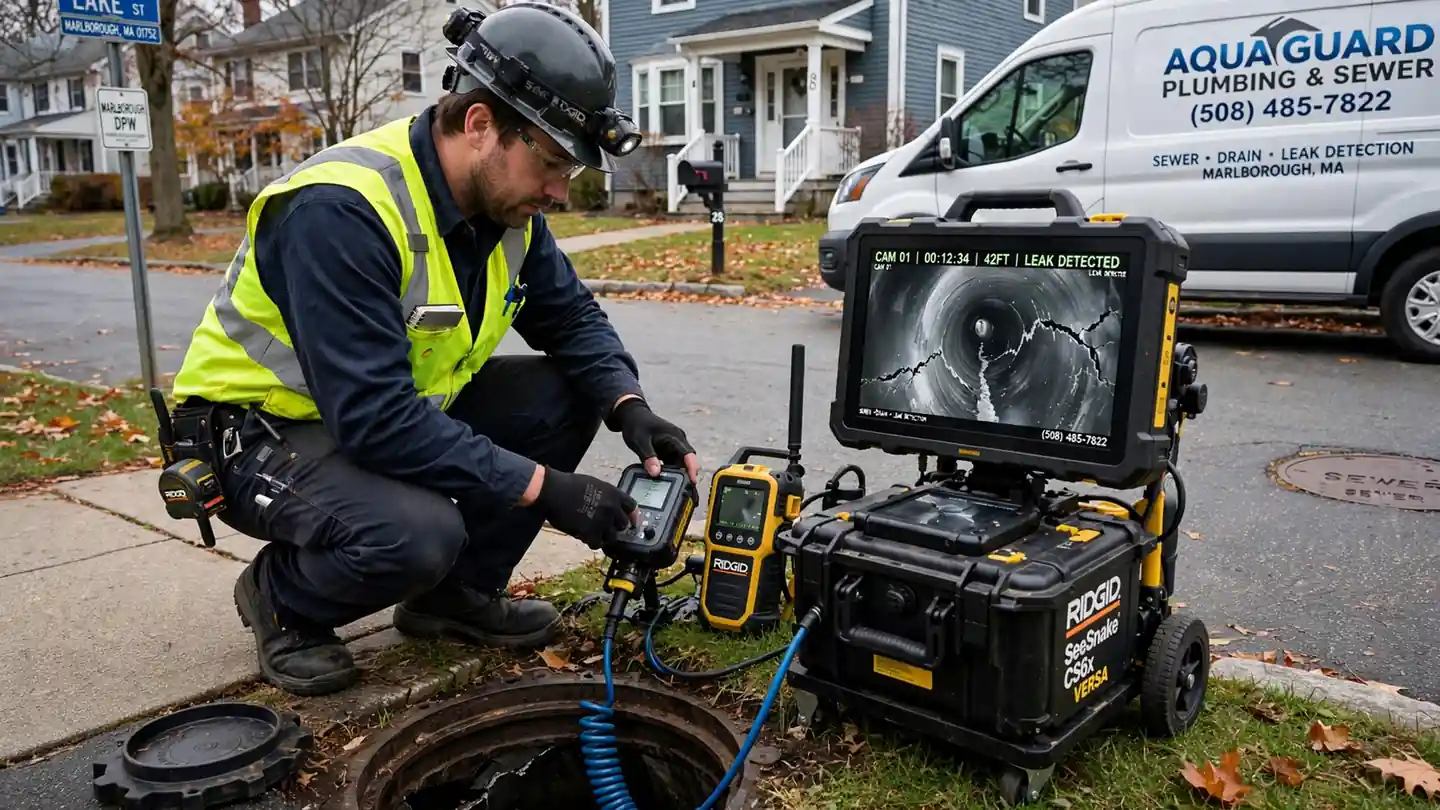
Marlborough, MA sewer leak detection
Sewer leak detection finds where a lateral is losing wastewater — or admitting groundwater — using camera inspection, acoustic listening, smoke testing, and dye tracing, pinpointing the leak so repair targets one spot instead of a whole yard.
IN SHORT
Sewer leak detection finds where a lateral is losing wastewater — or admitting groundwater — using camera inspection, acoustic listening, smoke testing, and dye tracing, pinpointing the leak so repair targets one spot instead of a whole yard.
A sewer leak is different from a sewer blockage, and it misleads homeowners constantly. A blockage announces itself with slow drains and backups. A leak whispers: a patch of lawn that stays green in August, a faint sewage odor near the foundation, a water bill that creeps without explanation, or damp soil along the lateral path that never quite dries. By the time a leak is obvious, it has usually been leaking for months.
Finding the leak is a detection discipline, not a digging discipline. Excavating a lateral to 'see where it leaks' destroys the yard to answer a question that instruments answer better. The toolkit is layered: camera inspection shows cracks, separated joints, and active infiltration directly; acoustic listening picks up the hiss of water escaping under pressure or the gurgle of infiltration; smoke testing fills the system with theatrical smoke that exits exactly where the pipe is breached; dye tracing follows colored water from fixture to daylight to prove a connection path.
Each method has its territory. Cameras rule inside the pipe — nothing beats seeing the crack. Smoke testing rules for finding breaches that vent to the surface: it reveals broken vents, dry traps, and yard leaks by where the smoke appears. Acoustic methods help on pressurized or partially pressurized sections. Dye proves flow paths when the question is 'does this drain connect to that leak.' A competent detection visit uses the right combination rather than forcing one tool onto every problem.
Leaks matter beyond the water bill. Wastewater leaking from a lateral saturates soil, undermines bedding, and can migrate toward foundations — where it becomes a structural and health problem. Infiltration running the other direction — groundwater entering through the same defects — overloads the lateral and, in some municipalities, the treatment system. Either way, the defect is a hole that needs finding and sealing.
In Marlborough, leak detection follows the housing stock. Clay laterals with separated joints leak at every coupling in Bolton and Stow farmhouses; cast-iron drains in mill-era homes weep at hubs and cracks; lake-adjacent properties in Fort Meadow and Lake Williams show infiltration where high water tables press against every defect. The detection method is chosen for the symptom, but the housing stock predicts where we will find it.
Warning signs
Common causes
How it works
Equipment
Safety
Smoke testing uses non-toxic theatrical smoke, but we notify the household before the test and ventilate if smoke enters through a dry trap — which itself diagnoses a defect.
Dye compounds are non-staining and environmentally safe, chosen specifically for tracing in residential systems.
If a leak has saturated soil near the foundation, we advise on keeping the area clear until the repair is complete — saturated bedding can shift.
All detection is non-destructive: the goal is to find the leak without opening the ground until the repair plan is set.
Local knowledge
Marlborough's clay-soil pockets and high water tables make leak detection a two-direction job. In the lake neighborhoods — Fort Meadow, Lake Williams — groundwater presses inward through every defect, so infiltration is often the visible symptom; in the till uplands, wastewater leaking outward shows as surface greening and damp soil. The detection plan accounts for which direction the water is moving before instruments come out.
The farmhouse belt — Bolton, Stow, Chapinville — carries the oldest clay laterals in the service area, and separated joints there leak at nearly every coupling. Smoke testing on these properties is remarkably productive: one test can map multiple breach points along a run, turning a vague 'somewhere it leaks' into a marked repair plan.
Winter complicates detection and makes it more valuable. Frozen ground caps surface symptoms — the green stripe disappears under snow — while frost heave actively opens new joint separations. A leak found in February explains the spring backup before it happens.
Service area
Sewer Leak Detection in Berlin, MA 01503.
Learn more →Sewer Leak Detection in Bolton, MA 01740.
Learn more →Sewer Leak Detection in Boxborough, MA 01719.
Learn more →Sewer Leak Detection in Carisbrook, MA 01752.
Learn more →Sewer Leak Detection in Chapinville, MA 01532.
Learn more →Sewer Leak Detection in Downtown Marlborough, MA 01752.
Learn more →Sewer Leak Detection in Fort Meadow, MA 01752.
Learn more →Sewer Leak Detection in Framingham, MA 01701.
Learn more →Sewer Leak Detection in French Hill, MA 01752.
Learn more →Sewer Leak Detection in Hopkinton, MA 01748.
Learn more →Sewer Leak Detection in Hudson, MA 01749.
Learn more →Sewer Leak Detection in Indian Head, MA 01752.
Learn more →Sewer Leak Detection in Lake Williams, MA 01752.
Learn more →Sewer Leak Detection in Maynard, MA 01754.
Learn more →Sewer Leak Detection in Nobscot, MA 01701.
Learn more →Sewer Leak Detection in Northborough, MA 01532.
Learn more →Sewer Leak Detection in Robin Hill, MA 01752.
Learn more →Sewer Leak Detection in Southborough, MA 01772.
Learn more →Sewer Leak Detection in Stow, MA 01775.
Learn more →Sewer Leak Detection in Sudbury, MA 01776.
Learn more →Sewer Leak Detection in West Village, MA 01752.
Learn more →Sewer Leak Detection in Westborough, MA 01581.
Learn more →With instruments, not shovels. Camera inspection sees cracks and separations directly; smoke testing reveals breaches by where smoke surfaces; acoustic listening hears escaping water; dye tracing proves flow paths. The methods converge on the leak point, and only then — with a repair plan — does any ground get opened, at one marked spot.
Yes. It uses non-toxic theatrical smoke, the same type used in stage productions. If smoke enters the house through a dry trap or broken vent, that itself pinpoints a defect — we ventilate and note the location. We always explain the test before starting.
It is the classic symptom. Wastewater fertilizes grass, so a lush stripe following the lateral's path in August is telling you where the pipe is breached. A camera inspection confirms the exact joint or crack — call (833) 713-2101 and we will take a look.
Yes — that is exactly what the instruments are for. Camera, acoustic, and smoke methods all work under slabs and pavement where excavation-for-diagnosis would be destructive. The leak is pinpointed first; the repair plan then chooses the least invasive fix, often lining.
A leak is wastewater escaping the pipe outward; infiltration is groundwater entering the pipe inward. The same defect — a cracked joint — does both depending on water levels. Detection identifies the defect; the repair seals both directions at once.
Usually one thorough visit does it: symptom interview, camera survey, and targeted testing in sequence. Complex cases — intermittent leaks that only appear in wet weather — may need a return visit under the right conditions, and we will tell you that upfront.
Small leaks grow. A weeping joint admits roots, erodes bedding soil, and in wet seasons becomes an infiltration point that can back the system up. Finding it early is what keeps a spot repair from becoming a line replacement.
Call (833) 713-2101 for sewer leak detection with camera-verified diagnosis.