Berlin
Sewer Line Replacement in Berlin, MA 01503.
Learn more →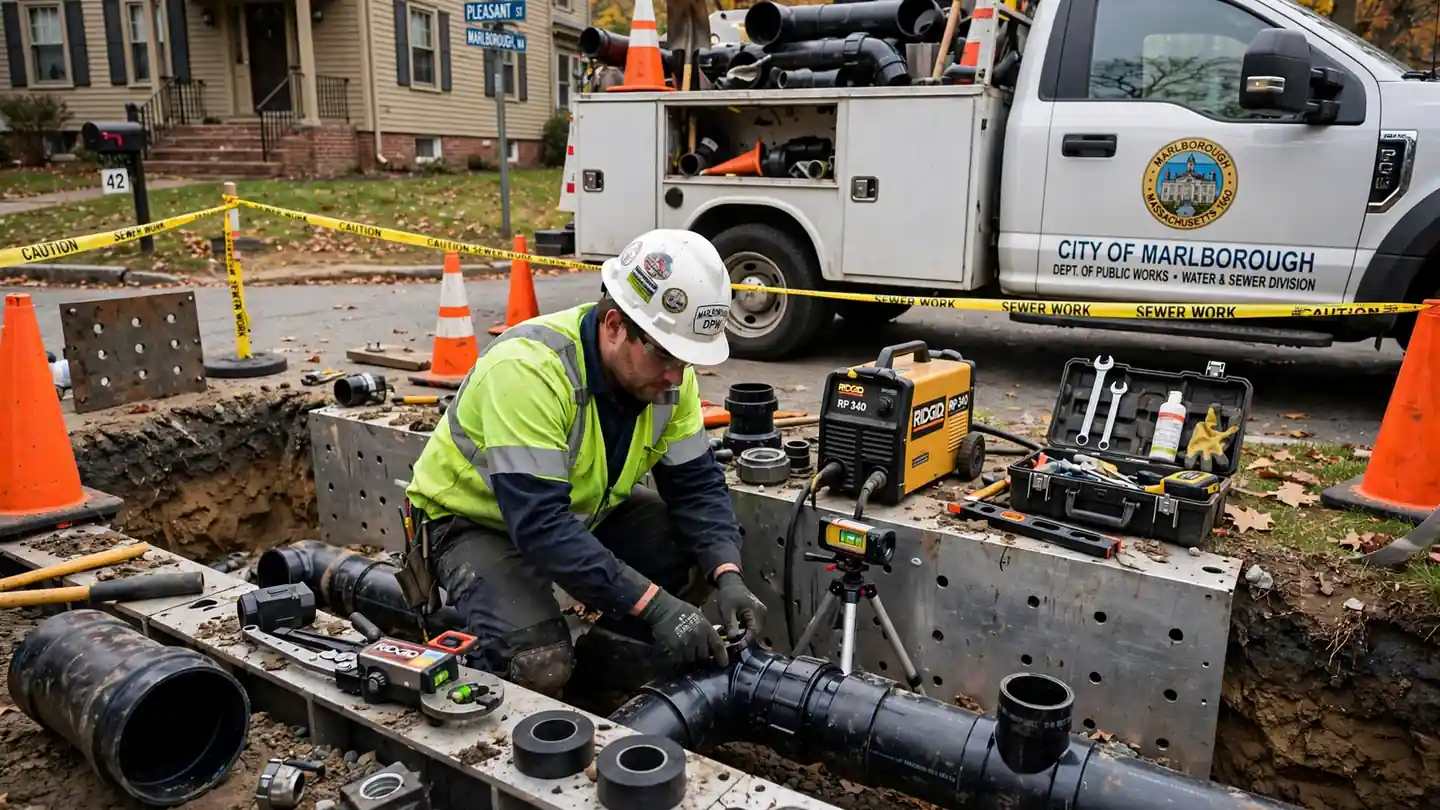
Marlborough, MA sewer line replacement
Sewer line replacement installs a brand-new lateral where repair no longer makes sense — collapsed pipe, widespread joint failure, or material past its service life — via trenchless bursting or open excavation, matched to the site.
IN SHORT
Sewer line replacement installs a brand-new lateral where repair no longer makes sense — collapsed pipe, widespread joint failure, or material past its service life — via trenchless bursting or open excavation, matched to the site.
There comes a point in every lateral's life when repair stops being the economical answer. A pipe with one bad joint is a repair candidate. A pipe with bad joints every six feet, a collapsed section, bellies holding water, and Orangeburg walls delaminating along the run is not a repair project — it is a replacement wearing a repair estimate. Knowing which side of that line your lateral falls on is what the camera inspection is for, and honest contractors show you the footage before recommending either path.
Replacement means a new pipe with a new service life. The methods divide into trenchless and open-cut. Trenchless pipe bursting fractures the old line outward while pulling new jointless HDPE through the same corridor — two pits, minimal surface disruption, and the option to upsize diameter. Open-cut excavation removes the old pipe and lays new pipe in an open trench — necessary where bursting cannot go (solid ledge, no pit access, unmarked utility conflicts) and sometimes the economical choice on clear, open ground where restoration is simple.
The decision framework is straightforward. Repair (spot fix or lining) wins when defects are isolated and the pipe's overall structure is sound — the 80-percent-healthy lateral with a 20-percent problem. Replacement wins when failure is systemic: collapse, widespread joint separation, material age-out across the whole run, or grade problems that lining cannot correct. Between them sits a gray zone where the camera footage, the property's plans (selling soon? renovating?), and the cost comparison decide.
What replacement is not: an emergency-midnight decision. A collapsed lateral can usually be relieved temporarily — flow restored with cabling — while the replacement is engineered properly: route surveyed, utilities located, method selected, permits pulled. The relief buys weeks; the engineering buys decades. Contractors who demand a same-night replacement decision are selling urgency, not plumbing.
In Marlborough, replacement demand concentrates where the oldest pipe lives: clay laterals under Bolton and Stow farmhouses with joints failed along the whole run, Orangeburg-era lines in 1950s subdivisions that have lost their shape, and cast-iron building drains downtown corroded past rehabilitation. Each of these has a replacement method that fits — bursting through till soils, excavation where ledge rules it out — and the camera plus the soil survey pick it.
Warning signs
Common causes
How it works
Equipment
Safety
Utility location and verification precede every replacement — the new route is proven clear before equipment mobilizes.
Trench safety (shoring/sloping) and pit barricading protect workers and the household throughout the project.
The work zone is separated from living areas; dust, noise, and access impacts are communicated in advance, not discovered mid-project.
Temporary drainage is maintained during the changeover so the household is never without working plumbing longer than planned.
Local knowledge
Marlborough's replacement map follows its oldest pipe. The farmhouse belt — Bolton, Stow, Chapinville — holds clay laterals whose joints have failed as systems after 80+ years; these are bursting candidates in till soils where the ground displaces cleanly. The 1950s–60s subdivisions hold Orangeburg and early cast iron at end of life; Nobscot's Campanelli-era slabs need under-slab strategy where replacement goes beneath concrete.
Soil decides method here more than most places. Dense drumlin till around Indian Head, Hudson, and Robin Hill bursts beautifully and trenches stably. Shallow ledge on hilltops can veto bursting — the head needs displaceable ground — and pushes those jobs to excavation or rerouted alignments. The pre-replacement survey reads the ground so the method matches it.
Downtown and Maynard's tight lots make the trenchless case on logistics alone: where an open trench cannot be staged, two pits usually can. Conversely, open rural lots in Berlin or Bolton with simple restoration sometimes make excavation the economical choice. The estimate should show both where both are viable.
Service area
Sewer Line Replacement in Berlin, MA 01503.
Learn more →Sewer Line Replacement in Bolton, MA 01740.
Learn more →Sewer Line Replacement in Boxborough, MA 01719.
Learn more →Sewer Line Replacement in Carisbrook, MA 01752.
Learn more →Sewer Line Replacement in Chapinville, MA 01532.
Learn more →Sewer Line Replacement in Downtown Marlborough, MA 01752.
Learn more →Sewer Line Replacement in Fort Meadow, MA 01752.
Learn more →Sewer Line Replacement in Framingham, MA 01701.
Learn more →Sewer Line Replacement in French Hill, MA 01752.
Learn more →Sewer Line Replacement in Hopkinton, MA 01748.
Learn more →Sewer Line Replacement in Hudson, MA 01749.
Learn more →Sewer Line Replacement in Indian Head, MA 01752.
Learn more →Sewer Line Replacement in Lake Williams, MA 01752.
Learn more →Sewer Line Replacement in Maynard, MA 01754.
Learn more →Sewer Line Replacement in Nobscot, MA 01701.
Learn more →Sewer Line Replacement in Northborough, MA 01532.
Learn more →Sewer Line Replacement in Robin Hill, MA 01752.
Learn more →Sewer Line Replacement in Southborough, MA 01772.
Learn more →Sewer Line Replacement in Stow, MA 01775.
Learn more →Sewer Line Replacement in Sudbury, MA 01776.
Learn more →Sewer Line Replacement in West Village, MA 01752.
Learn more →Sewer Line Replacement in Westborough, MA 01581.
Learn more →The camera footage decides, interpreted honestly: isolated defects in an otherwise sound pipe favor repair (spot fix or lining); systemic failure — collapse, joints failed along the run, material age-out — favors replacement. We show you the footage and explain which side of the line your lateral falls on. Call (833) 713-2101 for an inspection before deciding anything.
Not always — better is what fits the site. Bursting wins on minimal disruption and restoration savings; excavation wins where ledge, utilities, or access rule bursting out, and can be cheaper on open ground with simple restoration. We scope the viable methods from the survey and compare them openly.
A properly installed modern lateral — jointless HDPE or gasketed PVC, correct slope, proper bedding — is a multi-decade asset. 'Properly installed' is doing the heavy lifting in that sentence: grade verified by laser, joints assembled correctly, backfill compacted in lifts, camera-verified before close. That is the installation standard we hold.
Usually yes, trenchlessly — bursting pulls the new pipe through the old corridor without opening the driveway. Where bursting does not fit, we discuss the excavation path and its restoration honestly. The camera and soil survey determine which.
Planned to hours, not days. Temporary drainage is arranged during the changeover, and the sequence is scheduled so the household keeps working plumbing throughout. You will know the plan before work starts.
In bursting, it is fractured outward into the soil as the new pipe follows — inert fragments remain buried. In excavation, it is removed and hauled for proper disposal. Either way, nothing old remains in service.
If the camera shows the rest of the pipe is sound, a sectional approach can be right. If the 'good' sections are the same age and material as the failed one, replacing the run once beats a series of emergency sectional jobs. The footage — not a rule of thumb — makes the call.
Call (833) 713-2101 for sewer line replacement with camera-verified diagnosis.