Berlin
Pipe Bursting in Berlin, MA 01503.
Learn more →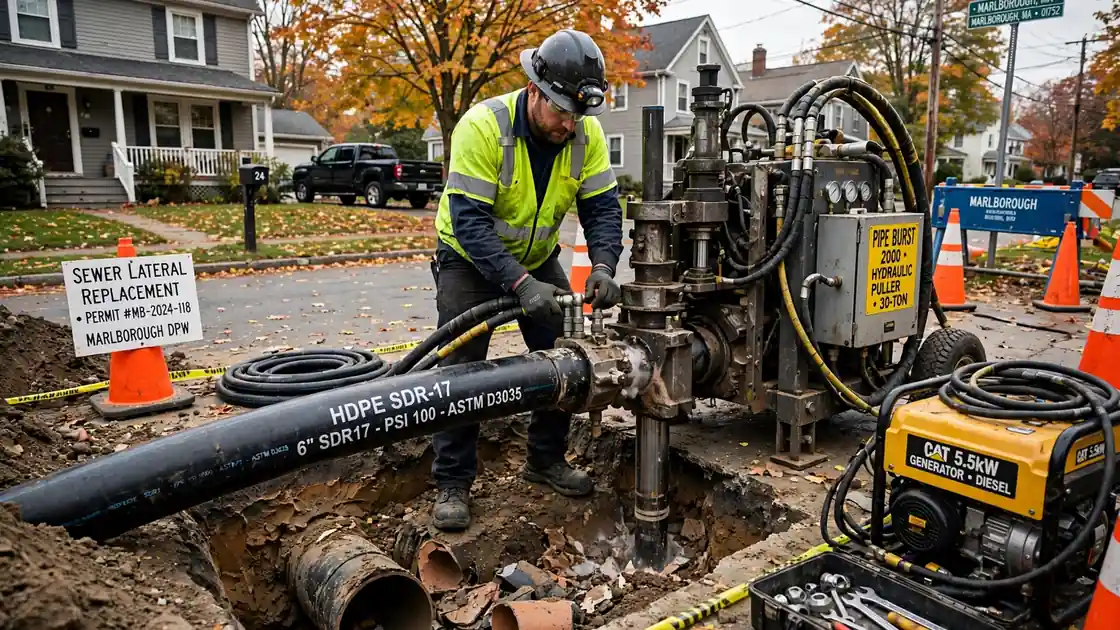
Marlborough, MA pipe bursting
Pipe bursting replaces a failed sewer lateral by fracturing the old pipe outward and pulling a new high-density polyethylene pipe through the same path — a trenchless replacement that needs only small pits instead of an open trench.
IN SHORT
Pipe bursting replaces a failed sewer lateral by fracturing the old pipe outward and pulling a new high-density polyethylene pipe through the same path — a trenchless replacement that needs only small pits instead of an open trench.
When a sewer lateral is too far gone for lining — collapsed sections, back-graded bellies, or pipe so deteriorated it has lost its shape — replacement is the honest answer. The traditional way means an open trench from the house to the street, tearing up lawns, driveways, patios, and sometimes sidewalks, then weeks of restoration. Pipe bursting achieves the same new pipe through a fraction of the digging.
The method is straightforward in concept and precise in execution. Two small pits are excavated: a launch pit at one end of the failed run and a receiving pit at the other. A hardened bursting head, slightly larger than the old pipe's diameter, is pulled or pushed through the existing line. As it advances, it fractures the old pipe outward into the surrounding soil — clay, concrete, cast iron, and Orangeburg all yield to it — while trailing a brand-new HDPE pipe into the exact path the old line occupied.
The new pipe is the point of the whole exercise. High-density polyethylene is fused into a single continuous run with no joints at all — and joints are where roots enter, where offsets form, where every lateral eventually fails. A jointless HDPE replacement eliminates the failure mode that destroyed its predecessor, which is why bursting is specified where root intrusion or joint separation caused the original failure.
Bursting also allows upsizing. Because the bursting head displaces soil outward, the new pipe can be a larger diameter than the old one — useful where the original lateral was undersized for the home's fixtures or where flow capacity needs a margin. Lining, by contrast, always slightly reduces diameter. When capacity matters, bursting is the trenchless method that adds it.
Not every line qualifies. The camera inspection comes first, always: severe bellies full of standing water, lines with unmarked utility crossings, or runs with no room for pits at either end can rule bursting out. A responsible contractor verifies candidacy on video before promising a trenchless replacement — and tells you plainly when open excavation is the better call.
Warning signs
Common causes
How it works
Equipment
Safety
Underground utilities are located and marked before any pit is dug — gas, electric, water, and communications crossings are verified, not assumed.
Pits are shored or sloped to prevent collapse, and open excavations are barricaded and covered at the end of each workday.
The bursting pull is a high-force operation; only trained operators work near the rigging, and bystanders stay clear of the pull path.
Soil displaced by bursting is compacted and pits are backfilled in lifts, then restored to match the surrounding grade and surface.
Local knowledge
Marlborough's glacial soils shape every bursting job. Dense till and drumlin country — the ground under Hudson, Stow, Indian Head, and Robin Hill — bursts cleanly because the soil holds the displacement, while shallow ledge on hilltops can stop a head cold. That is why the camera inspection includes a hard look at soil conditions and depth: bursting is ideal in till, questionable in ledge.
The city's older neighborhoods carry the laterals bursting was made for: clay tile with a root at every joint in Bolton and Stow farmhouses, Orangeburg-era runs in 1950s subdivisions, and cast iron past its service life downtown. When the camera shows failure at joint after joint, bursting replaces the whole failure pattern — not just the worst spot.
Tight lots change the logistics. Downtown Marlborough and Maynard's mill streets often have no room for a full trench but do have room for two pits — and that difference is the entire economic case for bursting. The method was practically designed for streets where excavation equipment cannot stage.
Service area
Pipe Bursting in Berlin, MA 01503.
Learn more →Pipe Bursting in Bolton, MA 01740.
Learn more →Pipe Bursting in Boxborough, MA 01719.
Learn more →Pipe Bursting in Carisbrook, MA 01752.
Learn more →Pipe Bursting in Chapinville, MA 01532.
Learn more →Pipe Bursting in Downtown Marlborough, MA 01752.
Learn more →Pipe Bursting in Fort Meadow, MA 01752.
Learn more →Pipe Bursting in Framingham, MA 01701.
Learn more →Pipe Bursting in French Hill, MA 01752.
Learn more →Pipe Bursting in Hopkinton, MA 01748.
Learn more →Pipe Bursting in Hudson, MA 01749.
Learn more →Pipe Bursting in Indian Head, MA 01752.
Learn more →Pipe Bursting in Lake Williams, MA 01752.
Learn more →Pipe Bursting in Maynard, MA 01754.
Learn more →Pipe Bursting in Nobscot, MA 01701.
Learn more →Pipe Bursting in Northborough, MA 01532.
Learn more →Pipe Bursting in Robin Hill, MA 01752.
Learn more →Pipe Bursting in Southborough, MA 01772.
Learn more →Pipe Bursting in Stow, MA 01775.
Learn more →Pipe Bursting in Sudbury, MA 01776.
Learn more →Pipe Bursting in West Village, MA 01752.
Learn more →Pipe Bursting in Westborough, MA 01581.
Learn more →The camera inspection decides. Bursting needs a definable path from pit to pit, clearance from unmarked utilities, and soil that will displace — dense till is ideal, solid ledge is not. Collapsed sections are fine (bursting does not need an intact host pipe), but severe bellies full of water and lines with no pit access can rule it out. Call (833) 713-2101 for an inspection and we will show you the footage and give you a straight answer.
Far less than open-trench replacement. Only the two pits are excavated; the run between them is renewed underground. Landscaping, driveways, and patios over the line stay intact. Pits are backfilled, compacted, and restored when the job is done.
Yes. The HDPE pipe is heat-fused into a single continuous run before the pull — no bell joints, no couplings underground. Since joints are where roots enter and offsets form, a jointless replacement eliminates the failure mode that destroyed the old line.
Usually yes — upsizing is one of bursting's advantages over lining. The bursting head displaces soil outward, so the replacement can step up a diameter where the original was undersized. We confirm the municipal connection can accept the larger pipe before upsizing.
Most residential laterals are completed in a day once pits are dug, with restoration following. The camera inspection and utility locating happen beforehand on a separate visit. The dispatcher will lay out the sequence when you call (833) 713-2101 — no vague promises, just the plan.
It is fractured outward into the surrounding soil by the bursting head as the new pipe follows. Fragments remain buried and inert in the ground — there is nothing to haul away and no trench full of debris.
The comparison is not just the pipe — it is the pipe plus restoration. Open trenches mean excavating and then rebuilding lawns, driveways, walkways, and sometimes street cuts. Bursting avoids nearly all of that restoration cost, which is where trench jobs get expensive. We scope both options from the camera footage so you can compare honestly.
Call (833) 713-2101 for pipe bursting with camera-verified diagnosis.