Berlin
Pipe Lining in Berlin, MA 01503.
Learn more →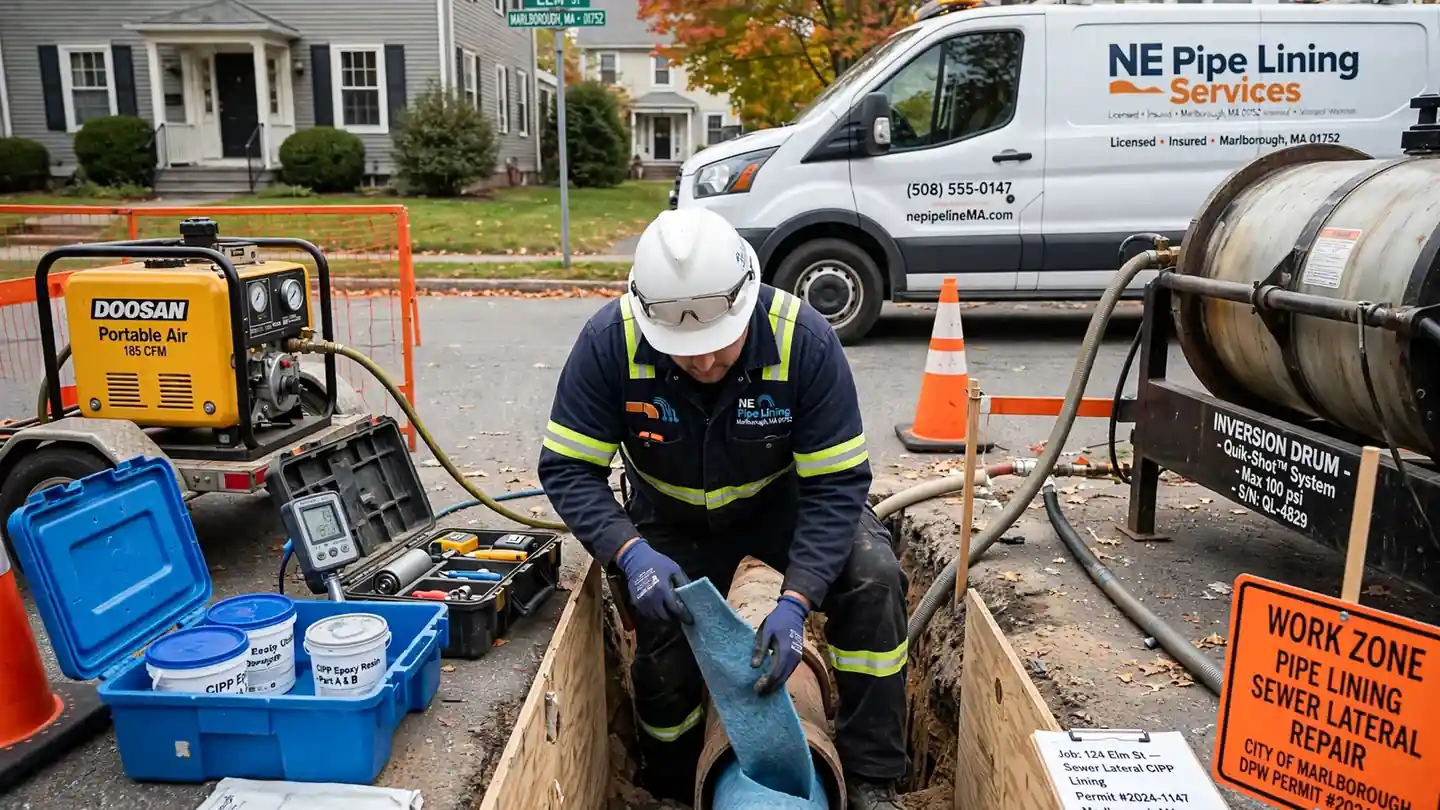
Marlborough, MA pipe lining
Pipe lining (CIPP) renews a sewer lateral from the inside: a resin-saturated liner is inverted or pulled into the old pipe and cured in place, creating a smooth, jointless new pipe within the old one — with no trench.
IN SHORT
Pipe lining (CIPP) renews a sewer lateral from the inside: a resin-saturated liner is inverted or pulled into the old pipe and cured in place, creating a smooth, jointless new pipe within the old one — with no trench.
Most sewer laterals do not fail all at once. They fail joint by joint — a root hair at one coupling, a small offset at the next, scale building inside cast iron year after year — until the cumulative damage chokes flow or collapses a section. Pipe lining, technically cured-in-place pipe (CIPP), addresses exactly this pattern: instead of replacing the pipe, it builds a new structural pipe inside the old one, sealing every joint, crack, and root entry in a single operation.
The process starts where every responsible sewer job starts: with a camera. The line is televised, measured, and cleaned — lining bonds to a clean host pipe, so descaling and root cutting come first. Then a felt or fiberglass liner saturated with epoxy resin is inverted or winched into the old pipe, pressed tight against the interior wall with air or water pressure, and cured with heat, steam, or UV light. When the cure completes, the old pipe is a form; the liner is the pipe.
The result is a jointless, corrosion-proof interior with a service life measured in decades. Roots cannot penetrate cured epoxy. Joints — the old failure points — no longer exist as separate pieces. Flow often improves because the smooth resin surface has less friction than scaled cast iron or rough clay, even though the diameter reduces slightly. For laterals with good structural shape but bad joints, it is the highest-value repair in the industry.
Lining's limits are honest and important. It needs a host pipe with enough remaining shape to form against — a fully collapsed section with no pipe left to line against is a job for bursting or excavation. Severe bellies that hold standing water will still hold water after lining, because the liner follows the old grade. And the lateral must be properly cleaned first; lining over heavy scale or active root masses is a shortcut that fails. The camera inspection is what separates a lining candidate from a replacement candidate.
In Marlborough, lining earns its keep in specific places: downtown multifamily buildings where excavation would shut down parking and access, historic districts and older neighborhoods where digging up mature landscaping is unthinkable, lake-adjacent streets where open trenches would hit groundwater immediately, and any property where the lateral runs under a new driveway, patio, or addition. When the camera shows a shaped-but-leaky pipe under something valuable, lining is usually the answer.
Warning signs
Common causes
How it works
Equipment
Safety
Epoxy resins are handled with proper ventilation and PPE; the work area is ventilated during inversion and curing, and residents are advised of the process timeline.
Lateral connections (branch tie-ins) are reinstated with robotic cutters after curing — every fixture connection is verified open on the final camera pass.
Bypass pumping keeps the home's drainage functional during the cure window so the household is not without plumbing.
All resin containers and waste are removed from the site; nothing is poured into drains or onto soil.
Local knowledge
Marlborough's housing stock makes lining a frequent recommendation. The city's median build year sits near 1971, which puts a huge share of laterals in the clay-and-cast-iron era — pipes with fundamentally sound barrels but failing joints. That is the textbook lining candidate: shape intact, joints leaking. Downtown's multifamily buildings, where excavation would displace parking and tenants, are especially strong lining cases.
The lake neighborhoods add a second argument. Around Fort Meadow Reservoir and Lake Williams, the water table runs high and open trenches fill with groundwater as fast as they are dug. Lining installs from existing access points with no dewatering, no trench collapse risk, and no muddy restoration — and the cured liner doubles as an infiltration seal against the same groundwater that made digging miserable.
Older farmhouses in Bolton, Stow, and the Chapinville area often have clay laterals running under stone walls, mature trees, and long driveways that no owner wants trenched. Lining preserves the landscape that gives those properties their character while renewing the pipe beneath it.
Service area
Pipe Lining in Berlin, MA 01503.
Learn more →Pipe Lining in Bolton, MA 01740.
Learn more →Pipe Lining in Boxborough, MA 01719.
Learn more →Pipe Lining in Carisbrook, MA 01752.
Learn more →Pipe Lining in Chapinville, MA 01532.
Learn more →Pipe Lining in Downtown Marlborough, MA 01752.
Learn more →Pipe Lining in Fort Meadow, MA 01752.
Learn more →Pipe Lining in Framingham, MA 01701.
Learn more →Pipe Lining in French Hill, MA 01752.
Learn more →Pipe Lining in Hopkinton, MA 01748.
Learn more →Pipe Lining in Hudson, MA 01749.
Learn more →Pipe Lining in Indian Head, MA 01752.
Learn more →Pipe Lining in Lake Williams, MA 01752.
Learn more →Pipe Lining in Maynard, MA 01754.
Learn more →Pipe Lining in Nobscot, MA 01701.
Learn more →Pipe Lining in Northborough, MA 01532.
Learn more →Pipe Lining in Robin Hill, MA 01752.
Learn more →Pipe Lining in Southborough, MA 01772.
Learn more →Pipe Lining in Stow, MA 01775.
Learn more →Pipe Lining in Sudbury, MA 01776.
Learn more →Pipe Lining in West Village, MA 01752.
Learn more →Pipe Lining in Westborough, MA 01581.
Learn more →The camera inspection answers it. Lining needs a host pipe with enough remaining shape — cracked joints, root entries, and moderate offsets are fine; a fully collapsed section with no pipe left, or a severe belly holding standing water, points to bursting or excavation instead. Call (833) 713-2101 and we will show you the footage and explain which category your line falls into.
A properly installed epoxy liner is a structural pipe with a multi-decade service life — it does not corrode, roots cannot penetrate it, and it has no joints to fail. The key phrase is 'properly installed': thorough cleaning, correct resin calibration, and full cure are what separate a decades-long liner from a failed one. Our final camera verification documents the installation.
Slightly — the liner wall has thickness, so the bore narrows by a small fraction. In practice, flow usually improves anyway because the smooth epoxy surface has far less friction than scaled cast iron or rough clay. Where capacity is already marginal, we discuss upsizing via bursting as the alternative.
The roots are cut and the pipe is descaled first — lining bonds to a clean host pipe. What lining does permanently is seal the joints the roots entered through, so the regrowth cycle ends. Lining over an unprepared pipe is a shortcut; we do not do shortcuts.
Yes — cast iron is one of the best lining candidates after descaling. The liner locks in the restored diameter and provides a corrosion-proof surface that will not re-scale the way bare iron does.
After the liner cures, each lateral connection is robotically reinstated — reopened with a cutter guided by camera — and every fixture is verified flowing on the final inspection. No connection is left sealed.
Lining typically needs only existing access points — cleanouts or small excavations at the ends. That is the core advantage: no trench through the yard, driveway, or landscaping. If access does not exist, a small pit may be dug, but nothing like an open-trench replacement.
Call (833) 713-2101 for pipe lining with camera-verified diagnosis.