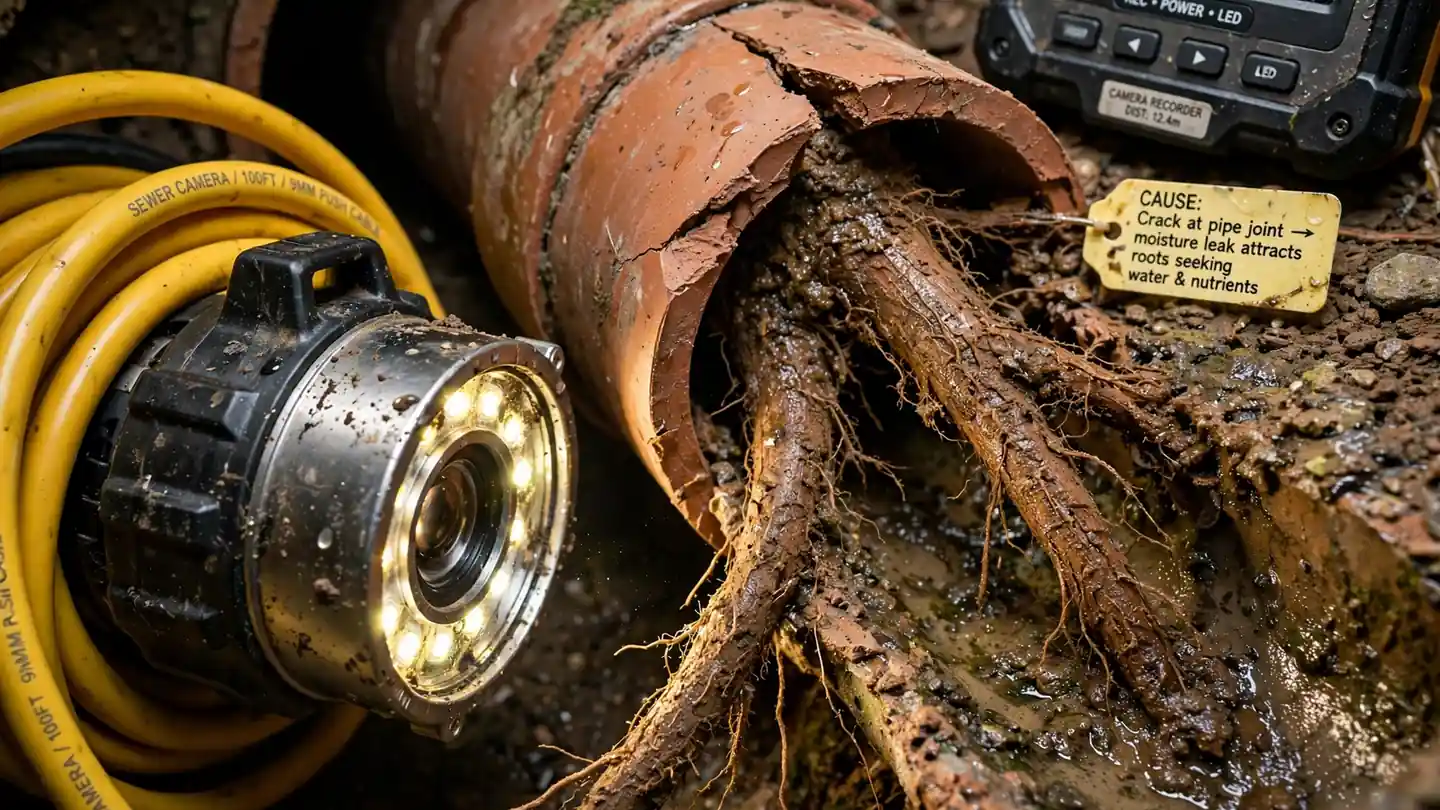
Tree roots enter sewer lines for the simplest reason in nature: water. A lateral with even a hairline joint separation leaks vapor into the surrounding soil, and roots — exquisitely sensitive to moisture gradients — grow toward it, enter the crack, and find a nutrient-rich paradise. What follows is biology versus plumbing, and biology is patient.
The entry points are almost always joints. Clay tile laterals have a joint every few feet; each is a potential entry once ground movement opens it microscopically. The vapor leak is the beacon — in dry soil, a leaking joint is the most attractive moisture source for many feet around, and the root system orients toward it with remarkable precision.
Once inside, the growth cycle compounds: the root hair thickens into a fibrous mass that snags toilet paper and solids, the mass traps more debris, the trapped debris feeds more growth. A root intrusion left for years can fill the pipe's bore entirely — the dense plug that the camera finds woven through the joint that started it all. Each season the roots also wedge the joint wider, converting a seep into a structural separation.
The usual suspects are the fast-growing, water-seeking species: maples, willows, oaks, elms — with mature specimens exerting the most pressure. But the pipe matters more than the species: any large tree near a clay lateral is a candidate, and laterals under old orchard rows face root systems with a century of growth. Distance helps but does not immunize — roots extend far beyond the canopy.
Prevention has two levels. The maintenance level is cutting on interval — mechanical removal timed to the regrowth cycle, typically annual where clay meets mature trees. The permanent level is sealing the entries: lining the joints shut with cured epoxy that roots cannot penetrate, or replacing the run with jointless pipe. Cutting without sealing is mowing without paving — effective, recurring, and ultimately more expensive than the permanent fix.
Chemical root killers deserve skepticism: they suppress regrowth temporarily without repairing the entries, risk harming desirable plantings, and add chemicals to the wastewater stream. Mechanical removal plus structural repair ends the cycle; chemicals postpone it with side effects.
In the Marlborough area, the root map follows the trees: the farmhouse belt's maples over antique clay (Stow is the acknowledged capital), street trees over old clay in Hudson, Maynard, and French Hill, orchard rows in Stow's farm country. Our tree root removal page details the service; the camera inspection maps your property's specific root reality.
The soil-moisture management around the lateral is the homeowner's lever: consistent deep watering of trees away from the pipe reduces the moisture gradient that draws roots toward the lateral. It does not seal joints, but it reduces the attraction — a supporting measure, not a solution.
The planting-distance guidance for the future: new trees planted with mature canopy distance from the lateral's corridor, root barriers where landscaping demands proximity. The next generation of trees need not repeat the current generation's conflict.
The species-selection note for replacements: where a tree must come down, its replacement can be a less aggressive species sited with the lateral in mind — the landscape plan and the pipe plan drawn together, not in opposition.
The area's signature trees are the repeat offenders: the maples and oaks shading Bolton's and Stow's older properties send roots deep and wide, the willows near the lakes and wetlands seek the lateral's moisture relentlessly, and even the ornamental plantings of the subdivisions find separated clay joints within a decade. The camera survey maps which trees are implicated — and the maintenance plan follows the root calendar, not the wall calendar.
FAQ
Questions
Frequently Asked Questions
No — cutting removes only the roots inside the pipe; the tree's structural root system is untouched. Chemical treatments are the actual risk to plantings, which is one reason mechanical removal is preferred.
Typically on a one- to two-year cycle where clay joints and mature trees coexist — the interval that sets the cutting schedule. Sealing the entries with lining ends the cycle permanently.
Rarely necessary: the pipe's joints are the problem, not the tree. Seal the joints (lining) or replace the run (bursting) and keep the tree — fix the pipe for the pipe's problem.
Healthy gasketed PVC resists root entry well; roots exploit damaged or poorly seated joints. Systemic root problems are overwhelmingly a clay-pipe story — the camera shows which story yours is: (833) 713-2101.