A collapsed sewer lateral is the end state of structural failure — the pipe's shape gone, flow stopped, soil where pipe should be. Understanding the causes helps you read the warning signs and, more importantly, act while the pipe is still repairable. Collapse is almost always the final chapter of a longer story.
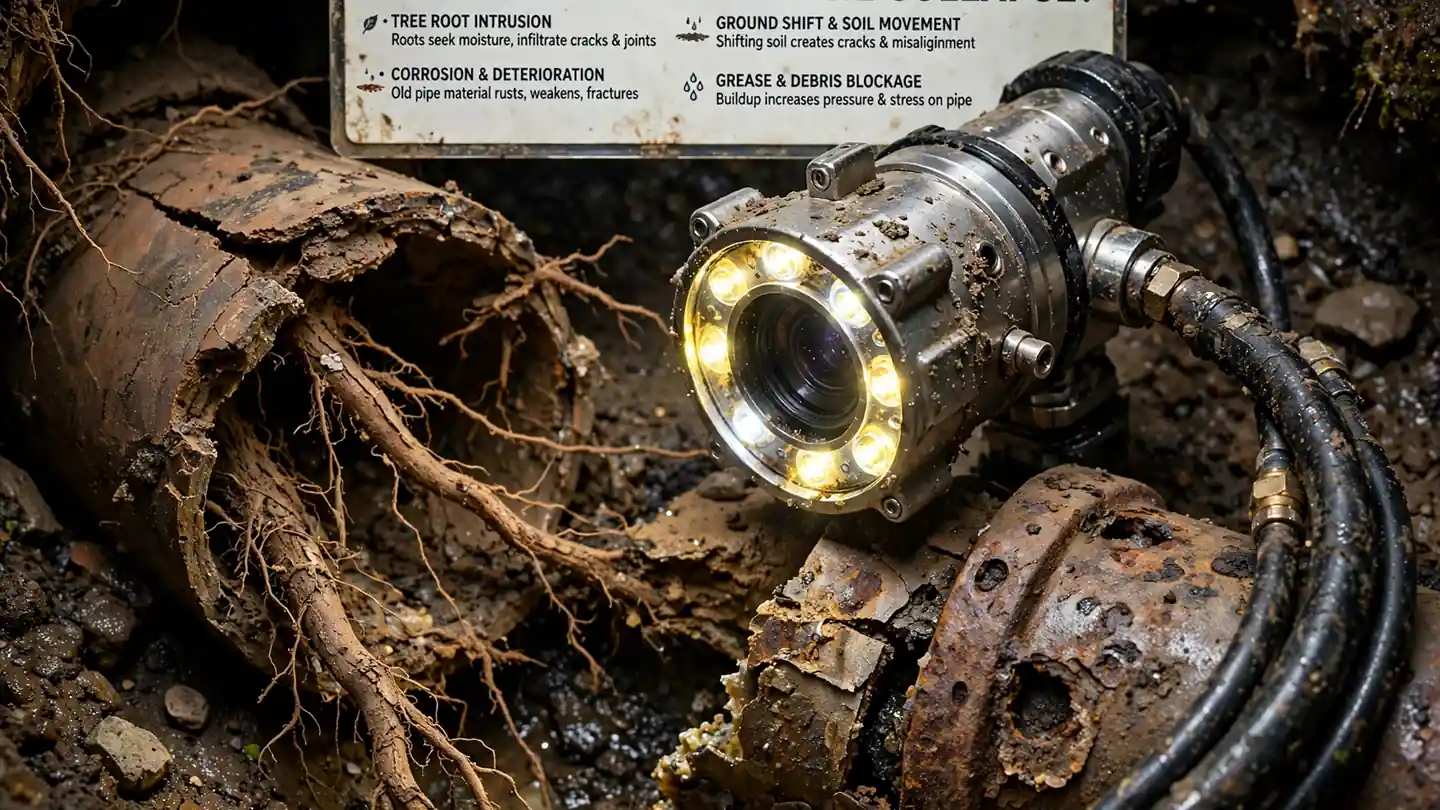
Material age-out is the most common author. Clay tile loses joint integrity over decades until sections shift and crush; Orangeburg deforms and delaminates until the flattened fiber cannot hold shape; cast iron corrodes through the wall until the remaining shell gives way. Every material has its curve, and laterals installed 50–80 years ago are on the steep part of theirs.
Ground movement writes the middle chapters: frost heave lifting and dropping sections annually, settlement compressing bedding, nearby construction or heavy traffic loading the soil above. Each cycle stresses the pipe slightly; the accumulation eventually exceeds what the weakened material tolerates. The farmhouse belt's century-old clay has lived through a hundred frost cycles — the joints kept score.
Root intrusion accelerates the ending. Roots entering joints wedge them wider season after season, and a sufficiently large root mass can displace segments outright — the collapse that the camera finds with roots still woven through the break. What began as a maintenance issue becomes a structural one if the cutting-and-lining decision is deferred too long.
Overloading contributes: the lateral sized for a 1950s household now serving additions, or the pipe crushed by surface loads it was never bedded for — heavy equipment crossings, new driveways, construction traffic. The pipe's structural margin was designed for its era's loads; exceeding them shortens the curve.
The warning signs precede the collapse by months or years: recurring blockages at shortening intervals, the camera showing deformation or advanced deterioration, bellies deepening, joints offsetting progressively. Collapse is sudden; the path to it is visible — which is why the camera inspection after the second repeat blockage is the decision point, not the fifth.
Once collapsed, the repair menu narrows honestly: lining is out (no host pipe to form against), leaving pipe bursting through the old corridor or open excavation. Both are well-established; the choice follows the ground, the access, and the corridor. Our sewer line replacement page details the paths; our Pipe Bursting in Bolton page shows bursting on farmhouse clay's home ground.
Prevention is the unglamorous moral: camera inspections that catch deformation early, lining that rehabilitates before collapse, and the maintenance that interrupts the root-and-movement cycle. The collapsed lateral is expensive; the inspected lateral is not.
The liability landscape after collapse is worth understanding: the owner's lateral is the owner's responsibility up to the municipal connection in most local codes — collapse does not transfer responsibility, though sudden municipal-main failures are the town's. The camera documents whose pipe failed, which is the factual basis for every responsibility question.
The temporary-relief options buy decision time: flow restoration via cabling where the collapse allows passage, bypass arrangements where it does not — the emergency visit stabilizes while the replacement is engineered. Relief is not repair, but it converts panic into planning.
The post-replacement documentation closes the chapter: new pipe footage, as-built route, inspection approvals — the collapsed lateral's replacement becomes the property's documented asset, and the next buyer inherits certainty instead of mystery.
Collapse patterns in the Marlborough area follow the soil and era: the clay farm laterals fail at joints stressed by root wedging and frost heave, the cast-iron mill-town lines fail from the inside out as corrosion thins the crown, and the shallow-burial sections anywhere fail from surface loading — the delivery truck, the dumpster, the construction equipment that the pipe was never designed to carry.
FAQ
Questions
Frequently Asked Questions
No — CIPP needs a host pipe with remaining shape to form against. Collapse leaves bursting or excavation; the camera confirms which sections have collapsed versus which are intact.
The camera shows the progression: deformation, advanced material loss, deepening bellies, progressive offsets. After the second repeat blockage, the inspection is the decision point — (833) 713-2101.
The event is sudden; the path is gradual. Months or years of warning signs — recurring blockages, visible deterioration — precede it. The suddenness is usually a failure to inspect, not a failure without warning.
Usually, where the corridor is definable and the ground displaces — collapse is bursting's natural territory. Ledge, utilities, or access constraints can still rule it out; the survey verifies before promising.