Trenchless versus traditional (open-trench) sewer repair is the method decision most homeowners face exactly once — and the comparison is routinely distorted by partisans of either side. This guide compares the approaches on the axes that actually matter: what each does, what each costs in total, what each disrupts, and when each wins.
Trenchless comprises two methods: pipe lining (CIPP), which builds a new structural pipe inside the old, and pipe bursting, which fractures the old pipe outward while pulling new jointless HDPE through the corridor. Both work through small access points — existing cleanouts or two pits — and leave the surface between them undisturbed.
Traditional repair is open-trench excavation: the corridor is dug open, the old pipe removed, new pipe laid to grade with proper bedding, then backfilled and restored. It is the oldest method, the most universally applicable, and the most disruptive — the surface above the pipe is fully opened along the run.
On total cost, the honest comparison includes restoration: trenchless concentrates cost in specialized equipment and materials with minimal restoration; excavation spreads cost across digging, dewatering where needed, and full surface restoration — lawn, driveway, pavement, landscaping. Where surfaces are valuable, trenchless usually wins total cost; where ground is open and restoration simple, excavation can win.
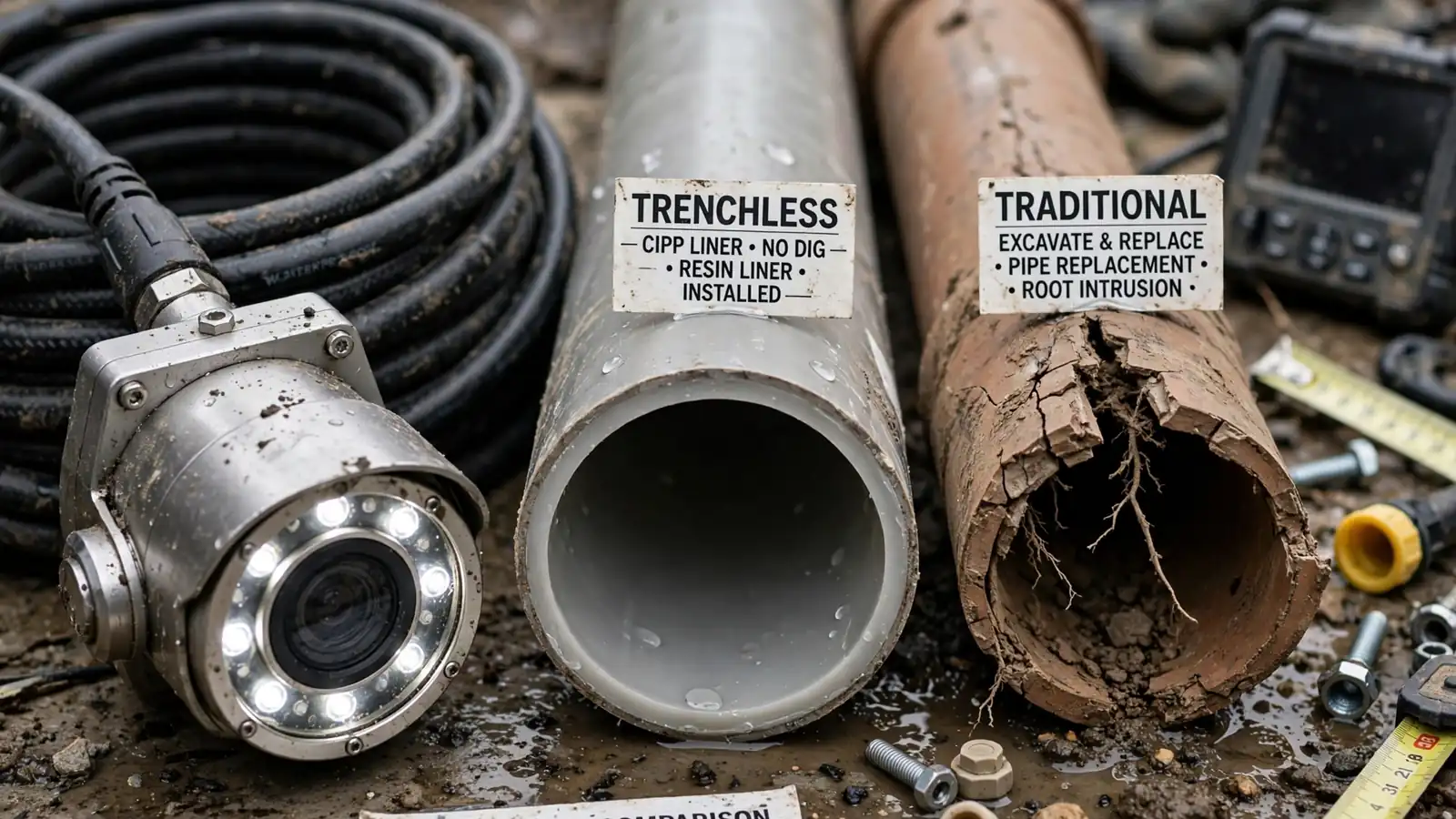
On disruption, trenchless wins decisively in most residential settings: days instead of weeks, access points instead of trenches, landscapes and driveways intact. Excavation's disruption is proportional to the corridor's value — a lawn is one thing, a new driveway or a downtown street is another.
On applicability, excavation wins: it handles every pipe condition, every soil, every depth — the universal method. Trenchless has candidacy requirements — lining needs a shaped host pipe, bursting needs displaceable soil and pit access — verified by camera and survey. When trenchless is ruled out, excavation is not the consolation prize; it is the correct method.
The decision framework: camera inspection first (the footage determines candidacy), total-cost comparison second (pipe plus restoration, scoped from the same footage), disruption tolerance third, and property plans fourth. Our pipe lining and pipe bursting pages detail the trenchless methods; our sewer line replacement page covers full-project scoping either way.
Beware the partisans: the contractor who recommends trenchless for every job and the one who dismisses it for every job are both selling, not diagnosing. The camera and the site survey pick the method — and the professional shows you why, on video and on the ground.
The environmental comparison favors the smaller footprint: less excavation means less soil disturbance, less hauling, less restoration material — the green argument for trenchless is the same as the disruption argument, measured in truckloads avoided.
The timeline comparison is concrete: trenchless residential projects typically complete in days; open-trench projects with restoration run weeks. For households and businesses, the timeline is often the deciding axis the price comparison cannot settle.
The resale comparison is documented: transferable verification footage and written scope add the same value regardless of method — the documentation, not the digging, is what buyers pay for. Insist on the paperwork either way.
The comparison plays out differently across Marlborough-area property types: the downtown Victorian with a lateral under a century-old maple and a stone foundation (trenchless preserves both), the Bolton farm property with a 200-foot run across open field (open trench may actually be cheaper where there's nothing to preserve), the Nobscot slab where the lateral runs under concrete (trenchless avoids the slab entirely). The 'better' method is a property-specific answer, and the honest contractor says so.
Municipal restoration costs tilt the math in the area's older town centers: where the lateral crosses a public sidewalk or street, the town's restoration specifications — and their price — apply to open-trench work but not to trenchless. In Hudson's and Marlborough's downtown districts, this restoration delta alone can exceed the method cost difference. The camera locates the defects; the site survey prices the surface.
FAQ
Questions
Frequently Asked Questions
Yes — the renewal is a new pipe by engineering measure: structural epoxy liners with multi-decade life, jointless HDPE bursting pipe. 'Trenchless' describes installation, not a durability compromise.
Where trenchless candidacy fails — collapse beyond bursting's reach, ledge blocking the head, utility conflicts, no pit access — or where open ground makes excavation economical. Demonstrated disqualification, not preference, should drive the choice.
Yes — sectional approaches use each method where it fits: lining the sound-but-leaky run, excavating the collapsed section. The camera scopes the combination.
One camera inspection, two scopes from the same footage (trenchless option and excavation option), each with full restoration and verification line items. Comparable scopes, honestly priced: (833) 713-2101.