Trenchless sewer repair is excellent — and it is not magic. An honest guide to its limitations is more useful than another list of its benefits, because knowing where trenchless stops keeps you from buying the wrong method. This post covers what lining and bursting cannot do, and what to do instead.
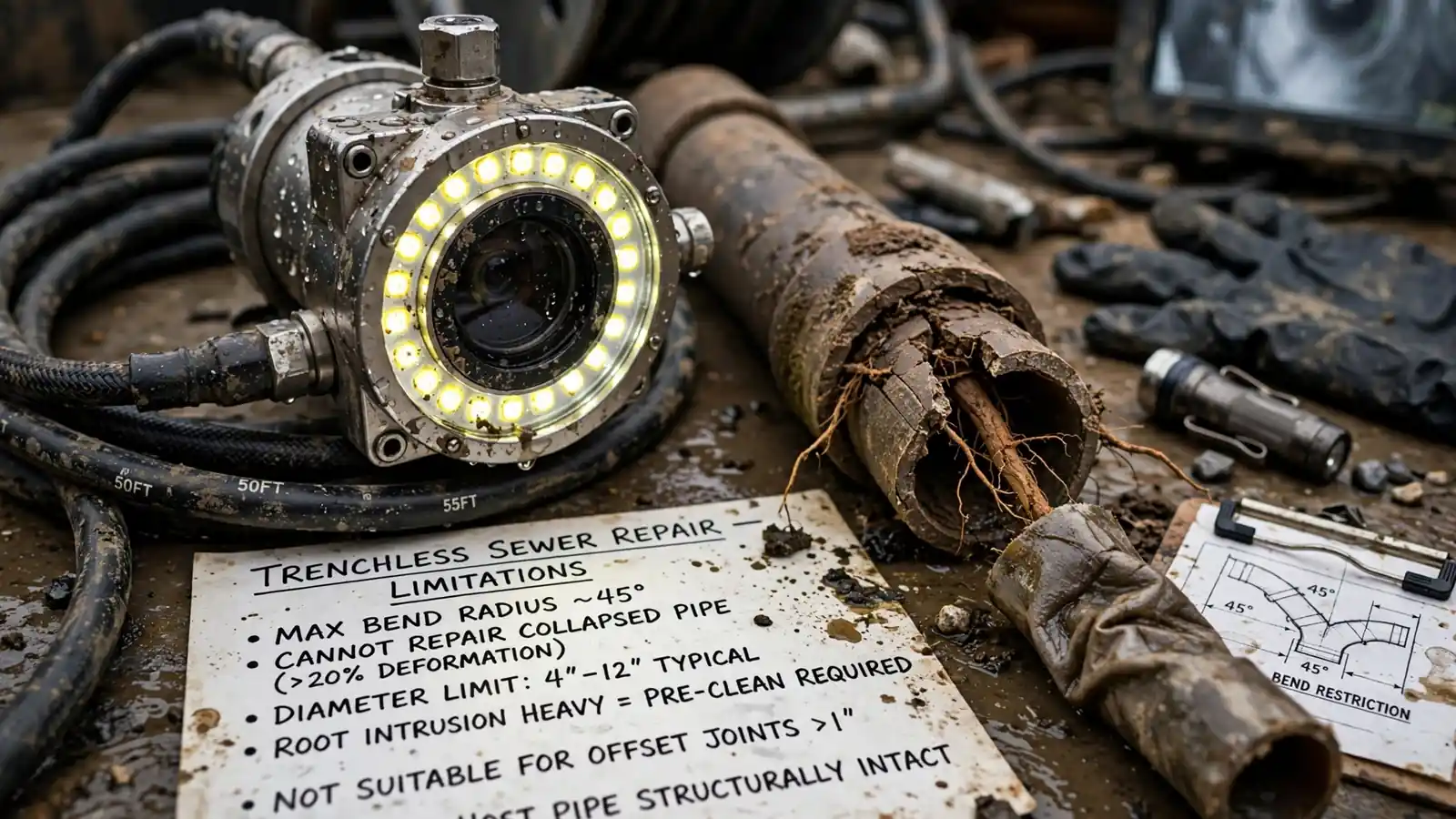
Lining's first limit is the host pipe: CIPP needs something to form against. Fully collapsed sections — where the pipe's shape is gone and soil fills the void — cannot be lined; the liner has nothing to press against. The camera shows collapse definitively, and the honest recommendation moves to bursting or excavation.
Lining's second limit is grade: the liner follows the old pipe's shape, including its bellies. A sagged section holding standing water will still hold standing water after lining — the pipe is renewed but the puddle remains, and solids will still settle there. Bellies need re-grading, which means bursting (new pipe at proper slope) or excavation.
Lining's third limit is diameter: the liner wall slightly reduces the bore. On adequately sized pipe this is irrelevant — the smooth surface flows better anyway. On marginally sized pipe, the reduction matters, and bursting's upsizing becomes the better trenchless answer.
Bursting's first limit is the ground: the head must displace soil, and solid ledge stops it. Shallow bedrock — the hilltop reality in places like Robin Hill and Indian Head — is the honest disqualifier the pre-work survey identifies before bursting is promised.
Bursting's second limit is the corridor: unmarked utility crossings, undefined pipe paths, and no room for pits at either end can each rule it out. The utility verification and the site survey are not bureaucratic steps — they are the candidacy decision.
Both methods share a limit: they cannot fix what the camera has not seen. Trenchless recommendations without inspection footage are the industry's red flag — the methods are precise, and precision requires the survey. Our trenchless sewer repair page covers the methods' strengths; this post's job is the boundaries.
When trenchless is ruled out, the alternatives are not failures: surgical excavation at the sonde-marked spot, sectional approaches combining methods, or rerouted new installation. The goal was never 'trenchless at all costs' — it is the right method for the pipe, the ground, and the property. The camera and the survey pick it honestly.
The access limitation is practical, not technical: lining needs an entry point, bursting needs two pits — properties with no cleanout and no pit locations need access created first, a small excavation that is still a fraction of trenching. Access creation is planned, not improvised.
The length limitation is logistical: very long runs may need sectional approaches or intermediate access, planned from the footage. Length does not disqualify trenchless — it structures it.
The expectation limitation is the human one: trenchless renews the pipe, not the property's entire drainage destiny — grading issues, foundation drainage, and municipal capacity remain their own projects. The honest scope is the pipe; the honest contractor says what is not included.
The area's housing stock creates specific limitation scenarios: the pre-1940 laterals with multiple sharp bends from hand-dug installations (bends that liners navigate poorly), the farm properties where the original clay was laid without consistent grade (bellies that lining preserves rather than corrects), and the shallow-burial sections where frost heave has created vertical offsets. Each is common in specific Marlborough-area neighborhoods — and each is why the camera survey precedes the method recommendation.
A candid limitation conversation includes the contractor's own boundaries: the installer who recommends lining for a collapsed section is telling you about their equipment inventory, not your pipe. In this market, the reputable answer to 'can you line this?' is sometimes 'no — and here's the footage showing why.' That no is worth more than a yes that fails in three years.
FAQ
Questions
Frequently Asked Questions
No — collapse without remaining shape is beyond lining's capability. Bursting or excavation handles collapse; the camera distinguishes collapse from intact-but-damaged, which is the entire candidacy question.
No — the liner follows existing grade, so standing water remains. Bellies need re-grading via bursting (new pipe at proper slope) or excavation. Mention bellies specifically when discussing options: (833) 713-2101.
Shallow bedrock can stop a bursting head — the pre-work survey identifies it before promises are made, and the plan pivots to excavation or sectional approaches honestly.
Not necessarily — excavation is the right answer where trenchless is ruled out. The question is whether the disqualification was demonstrated (footage, survey) or merely asserted. Demonstrated is professional; asserted is suspect.