Sewer lines rarely fail without warning — they broadcast distress signals for months before the emergency, and homeowners who recognize the signs get repairs on their schedule instead of the pipe's. This guide catalogs the warning signs in escalating order, from the subtle to the undeniable.
The early signs are easy to dismiss: a toilet that occasionally needs double-flushing, a shower that drains a little slower than it used to, gurgling from a drain when the washer runs. Each is a partial restriction speaking softly. The correct response is a camera inspection — the restriction is identified while it is still a maintenance item, and the fix is scheduled rather than suffered.
The middle signs demand attention: multiple fixtures slowing together (the main lateral, not a fixture clog), sewage odors from drains or near the foundation, wet-weather backups that clear when the rain stops. These indicate structural involvement — joints, roots, infiltration — and the camera inspection now scopes repair rather than maintenance.
The late signs are emergencies: sewage rising in tubs or floor drains, water pooling with foul odor near the foundation, toilets that will not flush at all. At this stage the response is the emergency protocol — stop water use, call (833) 713-2101 — followed by the camera diagnosis that scopes the permanent fix.
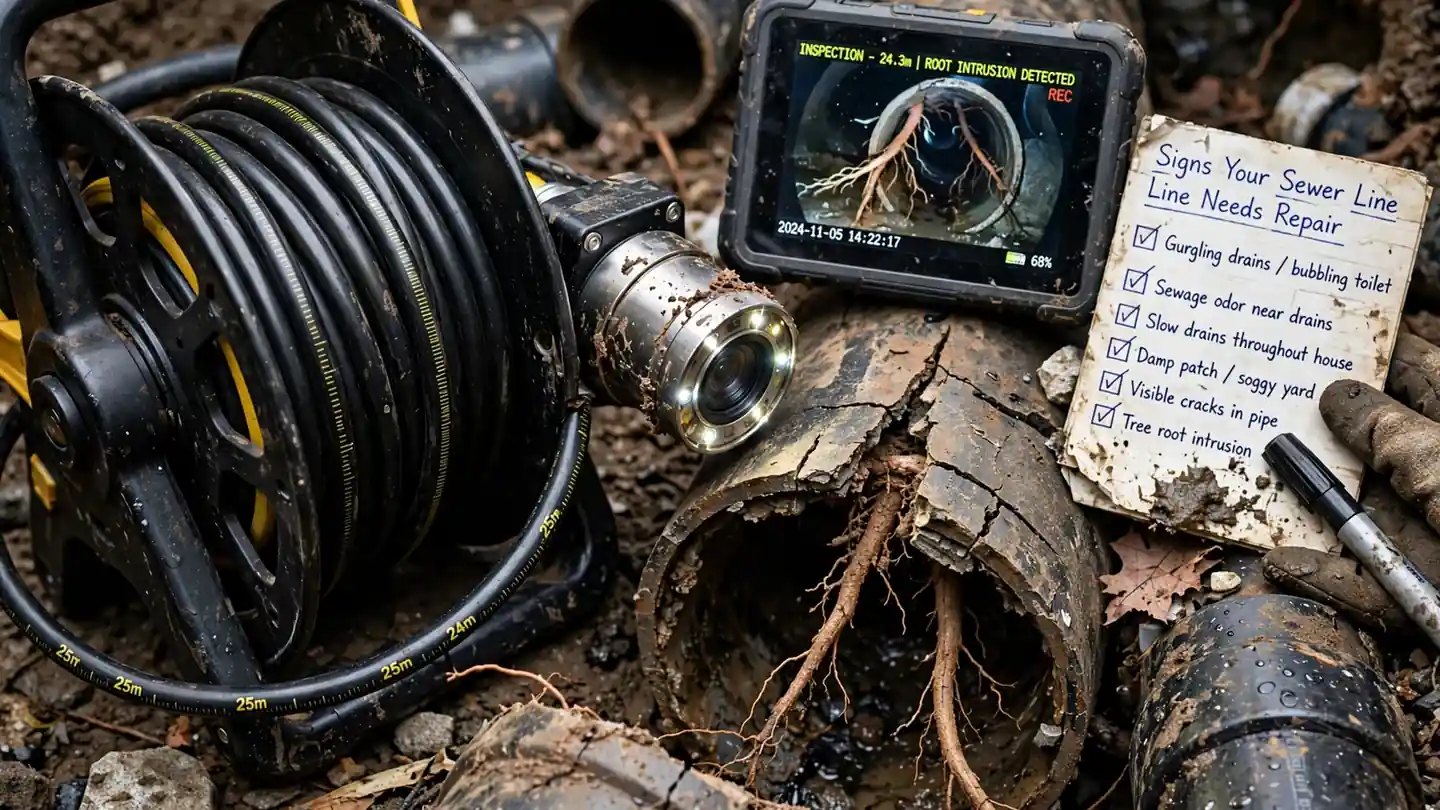
The outdoor signs are the most overlooked: a stripe of lush grass over the lateral's path in dry weather (wastewater fertilizing the lawn through a leaking joint), persistently soggy ground along the pipe's route, foundation dampness on the lateral side, and sinkholes or settling above the line. The yard often knows before the house does.
Seasonal patterns sharpen the reading: spring root growth accelerates clay-joint intrusion, summer storms expose infiltration defects, holiday cooking overloads grease lines, and January frost shifts shallow joints. A symptom's season is diagnostic data — mention it when you call, because it tells the technician where to look.
The response ladder is simple: early signs get inspection and scheduled care, middle signs get inspection and repair scoping, late signs get the emergency call. Every rung is cheaper than the one above it. Our sewer camera inspection page starts the ladder; our emergency sewer repair page covers the top rung nobody wants to reach.
The documentation habit turns signs into evidence: note dates, symptoms, weather, and which fixtures — the log that makes the technician's diagnosis faster and the insurance claim stronger. A symptom diary is the homeowner's cheapest diagnostic tool.
The neighbor-correlation check is free intelligence: simultaneous symptoms on the street implicate the municipal main, while isolated symptoms implicate your lateral. Ask before assuming — the answer changes who you call first.
The escalation protocol is the guide's actionable core: log early signs, schedule inspection at middle signs, call emergency at late signs — and never let a middle sign age into a late one through inattention. The protocol's cost curve is the entire argument.
Marlborough-area homes telegraph their lateral condition through local patterns: the gurgle that appears only during spring thaw (frost-shifted joint admitting groundwater), the slow drain that worsens every autumn (root growth peaking before dormancy), the basement floor drain that backs up during heavy rain but never otherwise (infiltration overwhelming a compromised lateral). Each pattern points to a specific defect class — and the camera confirms which.
The area's housing eras produce signature sign clusters: pre-1940 homes show the settlement-crack and joint-offset pattern, the 1950s-70s subdivisions show the root-invasion-through-separated-joints pattern, and the Campanelli-era slabs show the 'no cleanout, no warning' pattern where the first sign is the first backup. Knowing your home's era tells you which signs to watch for before they become emergencies.
FAQ
Questions
Frequently Asked Questions
Sewage rising in fixtures or floor drains — stop water use and call (833) 713-2101 immediately. Everything else on the list is 'schedule soon'; this one is 'now.'
Schedule-soon urgent: slow drainage is the early-to-middle stage, when inspection and planned repair are cheapest. Waiting converts it to the late stage at emergency prices plus damage.
Yes — intermittent symptoms are diagnostic: wet-weather-only points to infiltration, spring-worsening points to roots, usage-pattern symptoms point to capacity. Intermittence is information; report the pattern when you call.
Some can — a single slow fixture is usually the fixture, not the lateral. The pattern across multiple fixtures, outdoor signs, and seasonal timing is what implicates the lateral, and the camera confirms it definitively.