Clay, cast iron, Orangeburg, PVC, ABS, HDPE — the sewer lateral under your home is one of these, and its material predicts its failure modes, its remaining life, and its repair options. This guide covers each material's profile so you can understand what the camera inspection reveals about your specific pipe.
Vitrified clay tile is the historic standard: barrel sections joined every few feet, enormously durable as material, vulnerable at every joint. Clay's failure mode is joint failure — roots enter, ground movement offsets, infiltration follows. Lifespan is often quoted 50–60 years but describes the joints; lined clay (joints sealed) serves far longer. The farmhouse belt's clay laterals are the area's textbook case.
Cast iron drains by corrosion: internal tuberculation roughens and narrows the bore progressively, then perforates. The mill towns' cast iron is living this curve now — descaling restores diameter, lining locks in the restoration, and replacement ends the discussion when the wall is gone. Cast iron fails from the inside out, which is why the camera matters more than the calendar.
Orangeburg — bituminized fiber pipe, mid-20th century — is the cautionary material: 30–50 year life, deformation and delamination as failure modes, and no lining candidacy once it loses shape. If your camera shows flattened, blistered fiber pipe, the honest answers are bursting or excavation.
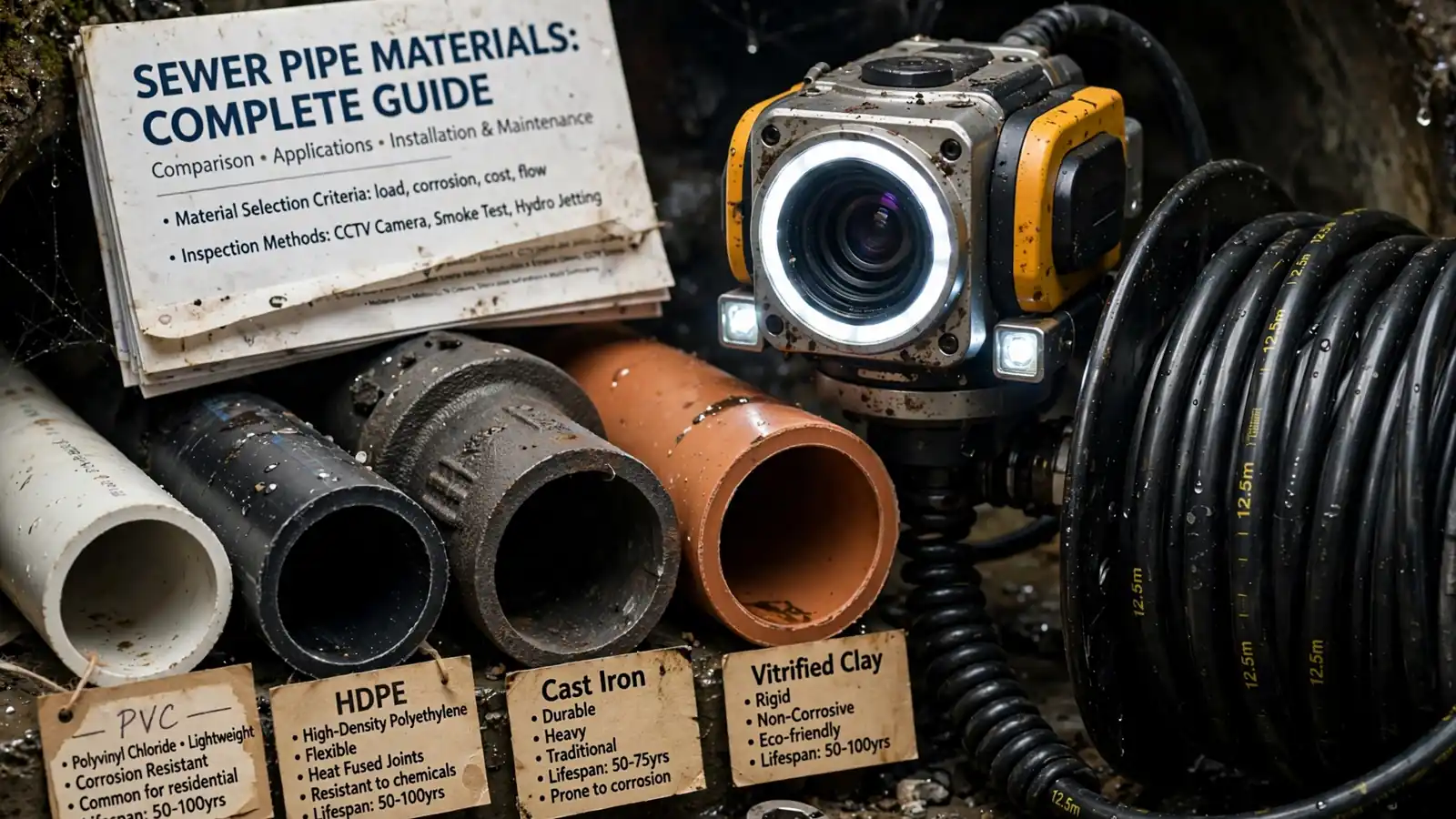
PVC and ABS are the modern standards: smooth bores, gasketed or solvent-welded joints, root-resistant by design, rated 100+ years. Their failures are mechanical — installation defects, crush damage, frost-shifted joints — not material aging. HDPE, the bursting replacement pipe, is the jointless modern option: fused continuous runs with no joints to fail.
The material determines the repair menu: clay with sound barrels lines beautifully; scaled cast iron descales then lines; collapsed anything bursts or excavates; Orangeburg goes trenchless-replacement or dig. The camera identifies your material and its condition — and the repair recommendation should reference both explicitly. Our pipe lining page covers the rehabilitation option; our sewer line replacement page covers the end-of-life path.
For Marlborough-area homeowners, the material map follows the housing: farmhouse clay in Bolton, Stow, and Chapinville; mill-era cast iron in Hudson, Maynard, and downtown; transition-era pipe in the 1970s–90s subdivisions; modern PVC in new construction. Your home's era suggests the material — the camera confirms it, because renovations and replacements have had decades to change the answer.
The transition coupling is the unsung hero of mixed-material laterals: shielded couplings joining clay to PVC, cast iron to ABS — each transition a potential weak point if improperly made, each verifiable on camera. The guide's practical takeaway: know your transitions, because the joints between materials fail before the materials themselves.
The age-dating skill is useful for buyers: hub-and-spigot cast iron, vitrified clay segments, Orangeburg's fiber texture, PVC's smooth uniformity — each visually distinctive on camera, each dating the installation era. The footage becomes a material history of the property's underground.
The replacement-material choice for new work is straightforward in this market: PVC for open-trench, HDPE for bursting — the modern standards with the track records. The decision is rarely the material; it is the method and the installer.
The material mix in Marlborough-area laterals follows the construction timeline: the pre-1940 housing (a fifth of the stock) runs vitrified clay and early cast iron; the post-war subdivisions through the 1970s run clay transitioning to cast iron and early PVC; the 1980s onward runs PVC and ABS almost exclusively. When the camera identifies your material, it's also dating your lateral — and the material's typical failure mode predicts what the footage will show next.
Replacement material selection in this region weighs the soil chemistry: the acidic soils in parts of the area accelerate cast-iron corrosion, making PVC or HDPE the rational replacement choice even where iron was original; the rocky till that shifts with frost heave rewards the flexible joints of PVC over rigid materials. The material that lasted longest elsewhere may not be the material that lasts longest in your soil.
FAQ
Questions
Frequently Asked Questions
The camera inspection identifies it visually — clay segments, cast-iron tuberculation, Orangeburg deformation, and PVC/ABS smoothness are all distinctive on video. Era suggests; footage confirms: (833) 713-2101.
For new installation: PVC or HDPE — the modern jointless-or-gasketed standards. For existing pipe, 'best' is the material already performing: sound clay lines beautifully, sound cast iron descales well. Condition beats material in the existing-pipe decision.
It is the shortest-lived lateral material, and deformed Orangeburg has the narrowest repair menu — but intact Orangeburg can sometimes be burst-replaced trenchlessly. The camera shows which situation you have.
Yes — with proper transition couplings, and the camera verifies existing transitions. Mixed-material laterals are common where sections were repaired across decades; each material gets its appropriate assessment.