Repair or replace — the most consequential question in sewer work, and the one most often answered by sales pressure instead of evidence. This guide lays out the honest comparison: what each path means, what each costs in total, and how the camera footage decides between them.
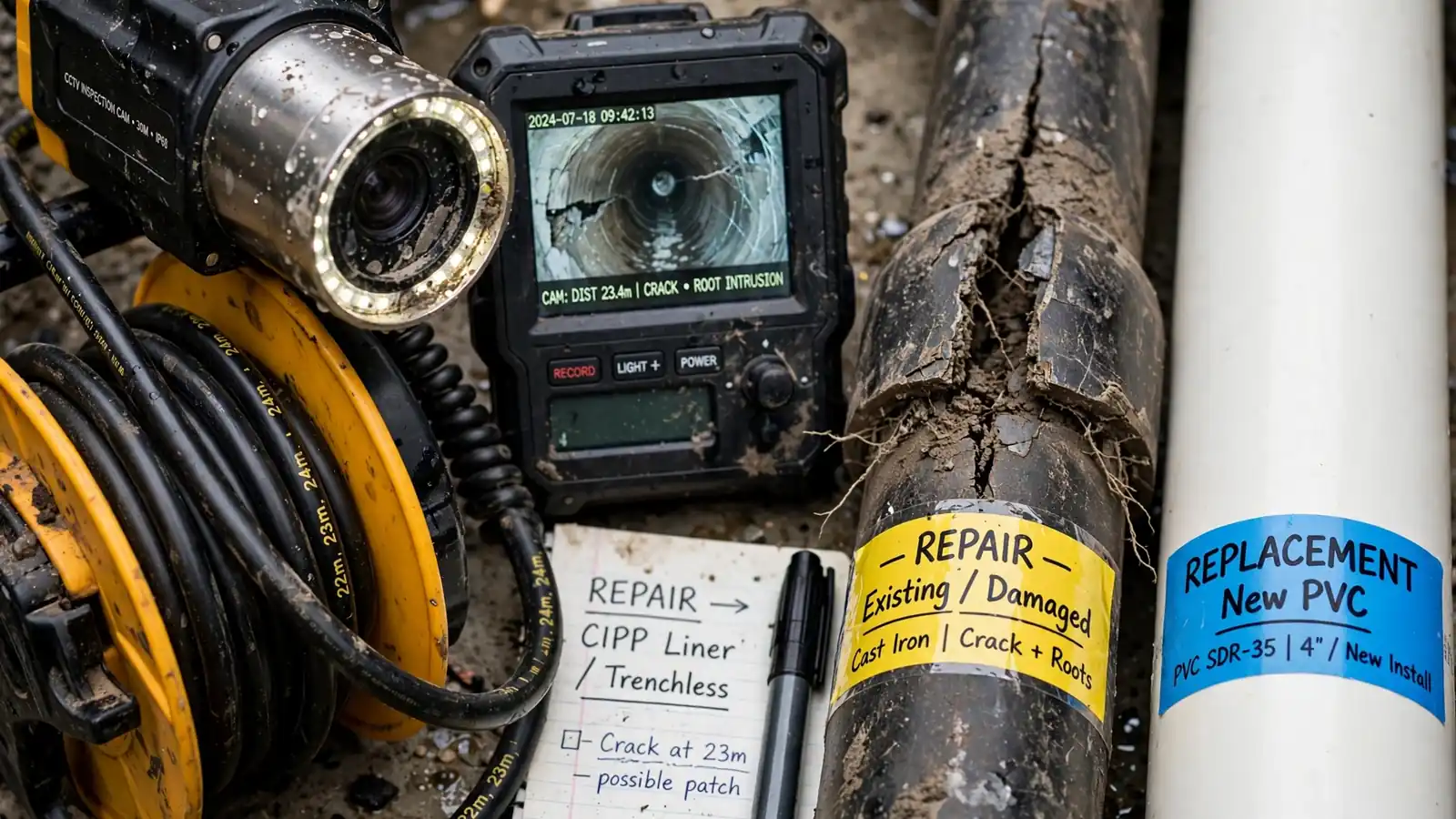
Repair means fixing the defective sections while keeping the pipe: spot repairs for isolated defects, or lining (CIPP) that builds a new structural pipe inside the old one along a run. Repair wins when the pipe's overall structure is sound — the 80-percent-healthy lateral with a 20-percent problem. Its advantages are lower disruption, faster completion, and lower project cost; its requirement is a pipe worth keeping.
Replacement means a new lateral with a new service life: trenchless pipe bursting through the old corridor, or open-trench excavation with new pipe laid to grade. Replacement wins when failure is systemic — collapse, joints failed along the run, material age-out, bellies that lining cannot correct. Its advantage is finality: the clock resets to zero. Its cost is higher disruption and higher project price.
The total-cost comparison is where honest decisions happen. Repair's project cost is lower, but a repaired-aging pipe may need further work — the comparison horizon matters. Replacement's project cost is higher, but it ends the repair cycle. The camera footage plus the pipe's age and material let you compare repair-plus-likely-future-work against replacement's finality over a ten-year horizon.
Disruption differs more than price: lining typically completes in a day with minimal surface impact; bursting needs two pits; excavation opens the corridor with full restoration. For downtown lots, finished basements, and valued landscapes, the disruption axis often decides what the price axis cannot.
The decision rule, stated plainly: isolated defects in sound pipe favor repair; systemic failure favors replacement; the gray zone — extensive but not total deterioration — is decided by the footage, the property's plans (selling soon argues differently than staying decades), and the honest ten-year math. Our sewer line replacement page details the replacement path; our pipe lining page details the rehabilitation path.
Red flags in the decision process: recommendations without camera footage, same-day pressure for either option, and quotes that do not show the footage supporting them. The camera is the referee — insist on seeing the video and having the defects explained before choosing. Call (833) 713-2101 for the inspection that makes the decision evidence-based.
The financing dimension is practical, not theoretical: replacement's higher project cost sometimes phases (sectional now, remainder planned) where repair's lower cost fits the immediate budget — but the ten-year math must include the phased remainder honestly. The camera determines whether phasing is legitimate staging or deferred reality.
The disruption-tolerance audit is personal: households with home offices, medical needs, or small children weight disruption differently than vacant properties. There is no wrong weighting — only the honest one, applied to the options the footage supports.
The second-opinion protocol protects the decision: footage in hand, written scopes from the options, and one review by an independent eye before authorizing five-figure work. The protocol costs little and has saved many homeowners from the wrong path.
Marlborough-area real estate dynamics add a dimension the generic guides miss: in this market, a documented sewer lateral — camera footage, condition report, repair records — has become a listing asset, while an undocumented lateral is a negotiation liability. Sellers who invest in the camera survey before listing control the narrative; sellers who wait for the buyer's inspector to find the problem negotiate from weakness. The repair-versus-replace decision made early is a pricing decision; made late, it's a concession.
The area's municipal sewer-averaging and betterment practices also factor in: where the town has assessed betterments for sewer extensions or replacements, the property's lateral history may already be partially documented in municipal records — worth checking before paying for a full survey. The town engineering office can confirm what they hold on your street's infrastructure history.
FAQ
Questions
Frequently Asked Questions
Yes — sectional replacement addresses the failed portion when the rest of the pipe is genuinely sound. When the 'sound' sections share the failed section's age and material, full replacement usually wins the ten-year math.
Rehabilitation — between the two. It renews the pipe's interior structurally without replacing the pipe itself. For joint-failed but shape-sound pipe, it is often the highest-value option.
Footage first: the recommendation should walk you through the video, pointing at the defects that justify it. Vague recommendations without specific footage are the warning sign.
Yes — a new or rehabilitated lateral with documentation is a selling asset; a failing one is a negotiation liability. The camera report serves both sides of a transaction.