This is the decision framework companion to our repair-vs-replacement comparison — not the what, but the how: a step-by-step process for reaching the right answer for your property, your pipe, and your plans.
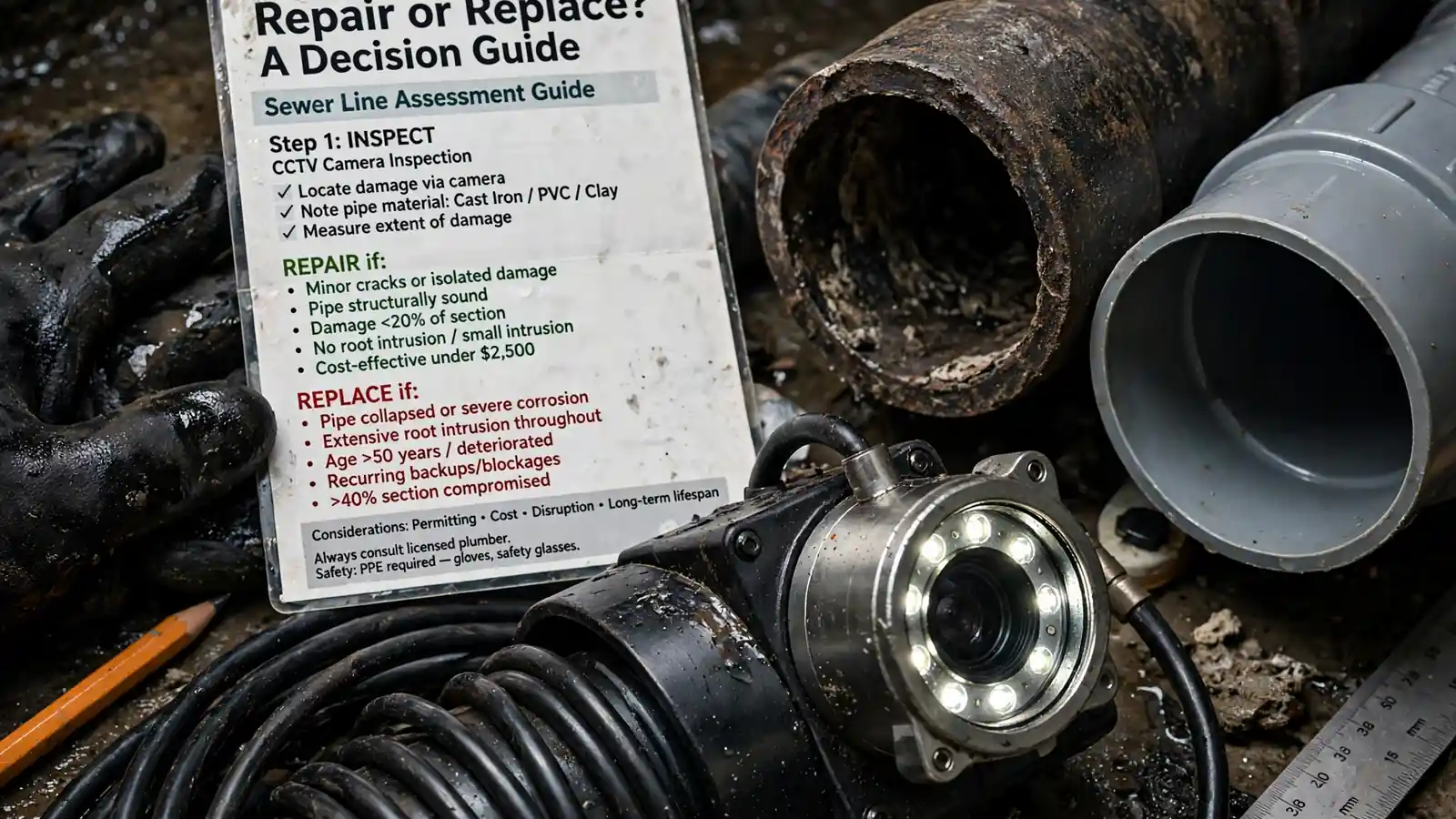
Step one: get the footage. Nothing else in this framework works without a current camera inspection with distance-marked defects. If a contractor is advising you without video, stop and get the inspection — it is the highest-leverage money in the entire decision.
Step two: classify the pipe. Sound with isolated defects (repair territory), systemically failed (replacement territory), or the gray zone of extensive-but-partial deterioration. Ask the inspector to state the classification explicitly and show you the footage supporting it — 'show me the worst three defects' is the question that cuts through vagueness.
Step three: price the real options. Get the repair scope (spot, lining, or sectional) and the replacement scope (bursting or excavation) priced from the same footage, each with full scope — permits, restoration, verification. Compare total project costs, not pipe-only numbers, and run the ten-year horizon: repair-plus-likely-future-work versus replacement's finality.
Step four: weigh your property plans. Selling within a few years argues for the documented, warrantied solution that transfers cleanly — often lining or replacement with paperwork. Staying for decades argues for the longest service life per dollar. Landlords weigh tenant disruption; historic-property owners weigh preservation.
Step five: check the disruption axis. Can the property tolerate excavation, or do the lot, the basement, or the landscape demand trenchless? Sometimes the disruption constraint eliminates an otherwise viable option — and that is a legitimate decision input, not a compromise.
Step six: decide without pressure. The emergency visit restores function; this decision happens after, at a sane hour, with footage and written scopes in hand. Any party rushing step six is not serving your interests. Our sewer camera inspection page starts the framework at step one; call (833) 713-2101 when you are ready to begin.
The framework's output is confidence: whichever path you choose, you chose it from evidence, with the alternatives priced and the reasoning documented. That confidence is worth more than the price difference between the options — it is what lets you stop second-guessing after the work is done.
The documentation package that the framework produces — footage, classification, priced scopes, decision rationale — serves beyond the project: it transfers to buyers, supports insurance records, and anchors future maintenance. Decisions documented are assets; decisions remembered are anecdotes.
The timeline discipline keeps the framework honest: emergency relief immediately, inspection within days, options priced within weeks, decision at your pace. Structural decline is measured in seasons — the framework's unhurried sequence matches the problem's actual urgency.
The regret-minimization test closes the framework: whichever path you choose, will you still endorse it knowing what the footage showed? If yes, decide and proceed. If no, the framework has more work to do — return to the classification step, not to the sales conversation.
The decision calculus shifts with Marlborough-area property values and holding horizons: on a home you plan to keep for decades, the full replacement's higher upfront cost amortizes into the cheapest per-year option, while on a property you're preparing to sell, a documented trenchless repair with transferable records often satisfies buyers and inspectors at a fraction of the cost. The camera footage plus a written condition assessment lets you match the investment to the horizon honestly.
Local soil and access realities belong in the decision: a lateral under a mature oak canopy in Bolton (root pressure, long runs) pushes toward replacement with root-resistant material, while a short lateral under an intact driveway in a 1980s subdivision (isolated joint failure) is the textbook lining candidate. The area's patterns — clay farm laterals, cast-iron mill-town lines, slab-era concrete — each have a typical decision outcome the camera footage confirms or overrides.
FAQ
Questions
Frequently Asked Questions
Return to the footage: ask each to walk you through the video pointing at the defects justifying their recommendation. The one whose recommendation matches the visible evidence is the one to trust.
One thorough inspection with footage you keep is usually enough — the video is portable, and second opinions can review the same footage. Multiple excavations of opinion without new footage add cost, not clarity.
Once flow is restored and the situation is stable, the decision timeline is yours — weeks, not hours. Structural decline is measured in seasons, not days. Use the time to price options properly.
The framework holds, with tenant disruption weighted heavily — trenchless options gain value when vacancy or tenant impact carries cost. Documented work also protects the owner's asset records.