Sewer line cleaning and hydro jetting are often discussed as alternatives, but the accurate relationship is category and premium method: cleaning is the service, jetting is one of its methods — alongside cabling and descaling. This guide compares the methods so you understand what each does, when each fits, and what 'cleaning' should mean on your invoice.
Cabling is the mechanical cutter: a rotating steel cable with a head — blades for roots, augers for soft blockages — that punches through obstructions to restore flow. Its strength is speed and its limit is scope: cabling opens a path through the blockage but leaves the buildup on the pipe walls. For emergency relief, it is the right first tool; as maintenance, it is incomplete.
Hydro jetting is the scouring method: high-pressure water through specialized nozzles — forward jets to penetrate, rear jets to propel and flush — that strips grease, sludge, and root fibers from the entire pipe circumference and flushes debris downstream to the main. Its strength is completeness: jetting restores diameter, not just passage. Its requirement is a pipe that can take the pressure, confirmed by camera.
Descaling is the cast-iron specialist: spinning chain flails that strip tuberculation — the internal corrosion roughness — from iron pipe, restoring bore that neither cable nor jet fully recovers. On mill-era cast iron, descaling is often the difference between a functional drain and a replacement conversation.
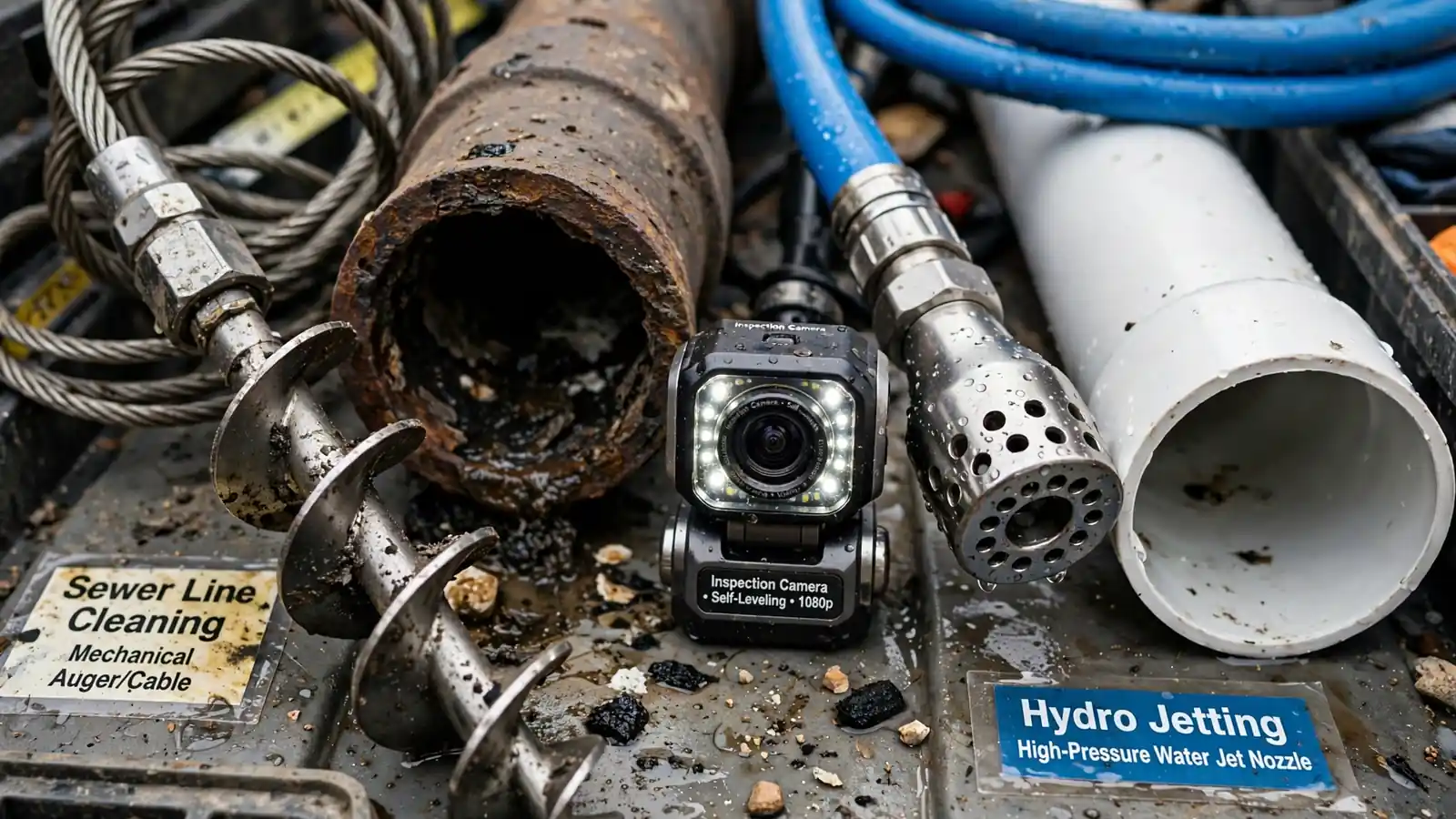
The method follows the diagnosis, which is why professional cleaning pairs with camera inspection. Jetting a collapsed pipe wastes the visit; cabling a grease choke without follow-up jetting guarantees the repeat; descaling without a camera misses the wall condition. The sequence — inspect, match method, verify — is what separates service from poking.
For Marlborough-area homes, the method map follows the pipe: clay laterals under the farmhouse belt get root cutting plus jetting flush; mill-town cast iron gets descaling on interval; kitchen lines everywhere get jetting for grease, heaviest before winter when fats congeal. Our sewer line cleaning page details the service; our sewer maintenance page sets the intervals.
Cost-effectiveness favors the right method over the cheapest visit: a jetting that restores diameter beats two cabling visits that each punch through, and a descaling that postpones replacement beats both. Ask what method is proposed and why — the answer reveals whether the provider diagnosed or defaulted.
The verification standard applies equally to every method: post-cleaning camera footage proving the line is clear and revealing the structural condition underneath. A cleaning visit without verification is an assertion; with footage, it is a documented service. Insist on the camera pass regardless of method.
Nozzle selection is jetting's hidden expertise: penetrating nozzles for blockages, rotating nozzles for wall scouring, root-cutting nozzles for fibrous masses — the nozzle matched to the diagnosed problem. 'We jetted it' without nozzle specifics is the mechanical equivalent of 'we fixed it' without details.
The pressure question has a professional answer: matched to pipe material and condition, confirmed by pre-cleaning camera assessment. Excessive pressure on compromised pipe is the amateur's error; the professional's pressure is a calculated parameter, not a maximum setting.
The area's pipe materials dictate the cleaning-method choice more than marketing does: the clay laterals of the farm belt (brittle, jointed) respond well to careful jetting at moderate pressure but can be damaged by aggressive chain-flail attachments; the cast-iron lines of the mill towns (scaled, tuberculated) often need the descaling capability that jetting with proper nozzles provides; the PVC of newer subdivisions tolerates either. The technician matches the method to the material the camera reveals.
Seasonal timing matters for cleaning in this region: late-summer jetting clears the root growth before autumn's peak intrusion season, while spring cleaning addresses the grit and sediment that winter's freeze-thaw cycles wash into compromised joints. Properties with known root history do best on the late-summer schedule — the cleaning that prevents the autumn emergency call.
FAQ
Questions
Frequently Asked Questions
Matched to the pipe — pressure and nozzle selected for the material and condition, confirmed by camera first. What damages old pipes is the blockage-become-backup, not the professional cleaning. Call (833) 713-2101 for the camera assessment.
Cabling restores flow; jetting restores the pipe. Repeated cabling without wall cleaning is the most expensive maintenance — each visit buys less time than the last as buildup compounds.
Set from camera evidence: grease-prone kitchen lines annually or biennially, root-prone clay on the cutting cycle, cast iron on the descaling interval. The footage sets the schedule.
It flushes root fibers and clears the mass after cutting, but the cutting head does the severing — the methods sequence: cut, then jet, then verify on camera.