This guide covers what drives sewer line replacement cost — the factors, not the figures. Any contractor quoting a price without seeing your lateral on camera is guessing, and the guess is rarely in your favor. Understanding the cost drivers helps you evaluate estimates honestly and avoid both the lowball and the gouge.
Method is the first driver. Trenchless pipe bursting and open-trench excavation can differ substantially on the same property — not because one is inherently cheaper, but because the cost structures differ: bursting concentrates cost in specialized equipment and the HDPE pipe, while excavation spreads it across digging, dewatering, and surface restoration. The honest comparison is total project cost, scoped from the same camera footage.
Length and depth are the second driver. Laterals are priced substantially by the foot, and depth multiplies the difficulty: a shallow 40-foot run and a deep 120-foot run are different projects. Berlin's acreage laterals and Indian Head's drumlin depths illustrate the range within a single service area.
Ground conditions are the third driver. Dense till digs slowly, ledge stops bursting heads, high water tables demand dewatering — each condition adds its line to the estimate. This is why the pre-work survey matters: the estimate should reflect your ground, not a generic assumption.
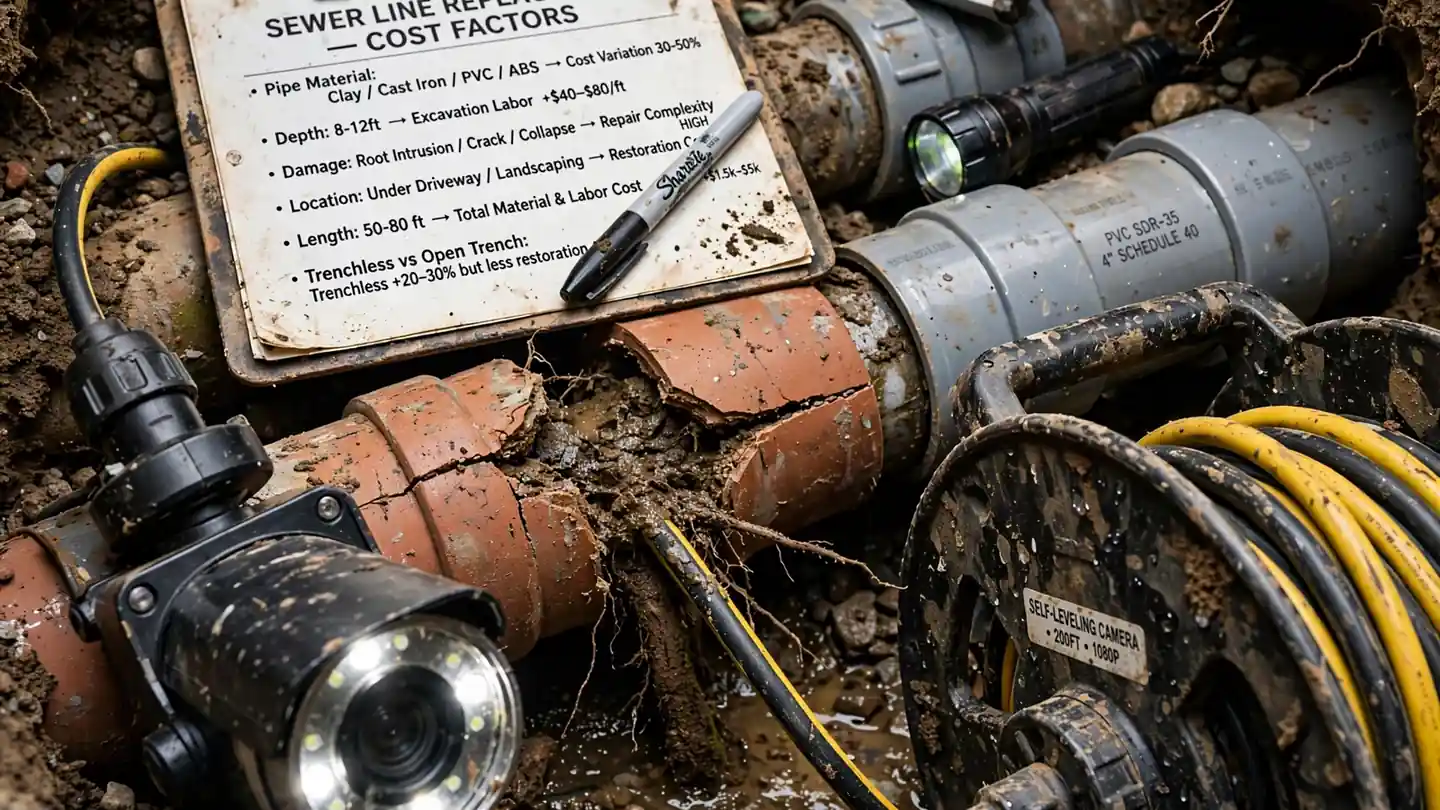
Access and restoration are the fourth driver, and often the largest surprise. A lateral under lawn restores cheaply; one under a new driveway, mature landscaping, or a downtown street restores expensively. Trenchless methods exist largely to collapse this cost category — the pipe work is comparable, the restoration is not.
The fifth driver is scope honesty: does the estimate cover permits, inspections, restoration, and verification — or just the pipe? The cheapest bid that omits restoration is the most expensive project. Demand line-item scope: method, length, depth, restoration, permits, and the camera verification that proves the work.
Red flags in estimating: quotes without camera footage, pressure for same-day decisions, vague restoration terms, and prices that seem disconnected from the described work. The antidote is always the same — footage first, written scope second, decision third. Our sewer line replacement page details the methods; our pipe bursting page explains the trenchless option's economics.
For budget planning, the useful exercise is the comparison the footage enables: repair versus replacement costs over the pipe's remaining life, not just the project price. A lining that extends service decades can beat a replacement on value; a replacement that ends serial emergencies beats repeated repairs. The camera makes the comparison real instead of theoretical.
Financing and phasing deserve practical mention: where the full replacement strains the budget, the camera sometimes supports a phased approach — the failed section now, the aging remainder on a planned timeline — though phasing costs more in total than doing it once. The footage determines whether phasing is honest or wishful.
The estimate-appointment itself is informative: a contractor who cameras first, measures, locates utilities, and then prices is doing the work that justifies the price. One who prices from the driveway is selling a number, not a project. The pre-estimate effort predicts the project's quality.
Value engineering — legitimate cost reduction — comes from method selection and scope precision, not from cutting verification or restoration. The estimate that itemizes honestly is the one you can value-engineer with the contractor; the lump-sum guess is the one you cannot trust.
Local cost drivers in the Marlborough area include the rock-excavation factor (till and ledge underlying much of MetroWest), the municipal restoration specifications where laterals cross public ways, and the access constraints of the area's older neighborhoods — narrow lots, mature trees, stone walls that can't be disturbed. Quotes that itemize these factors are honest; quotes that don't are optimistic.
FAQ
Questions
Frequently Asked Questions
Because the cost drivers — method, length, depth, ground, restoration — are all property-specific, and quoting without camera footage is guessing. Reputable contractors inspect first; the estimate follows the footage. Call (833) 713-2101 for the inspection that makes pricing real.
Not on total project cost — compare pipe plus restoration, not pipe alone. Where surfaces are valuable, trenchless usually wins; where ground is open and restoration simple, excavation can win. The footage-scoped comparison is the honest one.
Method, length and depth, ground-condition allowances, access plan, restoration scope, permits and inspections, and post-installation camera verification — in writing. Missing line items are where surprise costs hide.
Check that both scoped from camera footage, both include restoration and permits, and both specify the method. Bids scoped from different assumptions are not comparable — normalize the scope first, then compare the numbers.