The honest answer to 'how long does a sewer line last' is: it depends on the pipe, the ground, and the maintenance — but the ranges are well established, and knowing where your lateral falls on the spectrum tells you whether to plan, monitor, or act. This guide covers material lifespans, what shortens them, and how Marlborough-area conditions affect the math.
Clay tile laterals — the farmhouse-belt standard — are often quoted at 50–60 years, but that number describes the joints more than the pipe: the clay barrel can last far longer while the joints fail progressively to roots and ground movement. A clay lateral's effective life is really the life of its joints, which is why lining (sealing every joint) can extend a clay line's service dramatically.
Cast-iron drains corrode from the inside, and their lifespan tracks water chemistry and usage more than the calendar — 50–75 years is the commonly cited range, with tuberculation narrowing the bore long before structural failure. Descaling plus lining can rehabilitate cast iron that is rough but sound; corrosion through the wall ends the discussion.
Orangeburg — the bituminized fiber pipe of the mid-20th century — is the shortest-lived: 30–50 years, with deformation and delamination as the failure modes. Once Orangeburg loses its round shape, the only honest answers are bursting or excavation. PVC and ABS, the modern materials, are rated for 100+ years — the laterals least likely to need your attention.
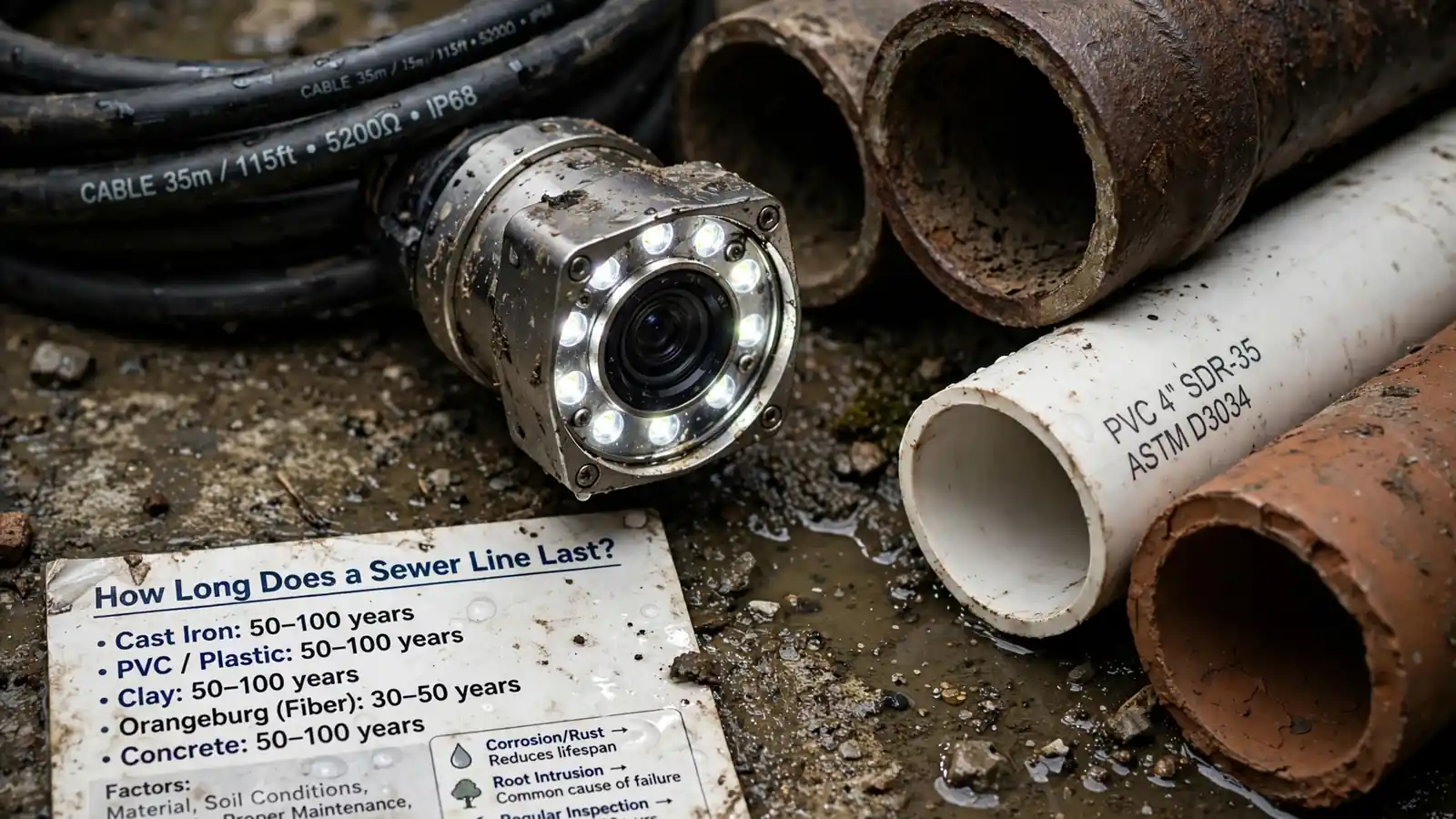
What shortens any pipe's life is consistent: root intrusion at joints, ground movement and frost heave, grease and scale accumulation, and neglect — the absence of the camera inspections that would have caught the treatable problems early. What extends it is equally consistent: scheduled maintenance, prompt attention to early symptoms, and trenchless rehabilitation at the right moment.
Marlborough-area conditions add local texture: freeze-thaw cycles work every joint annually, mature tree cover pressures clay laterals across the farmhouse belt and older neighborhoods, and the lake areas' high water tables keep defects wet and active. A lateral's lifespan here is lived in four seasons, and winter is the hardest one.
The practical question is not the textbook lifespan but your lateral's remaining life — and that is a camera question, not a table question. The footage shows where your pipe sits on its aging curve: early, mid-life, or approaching the decision point. Our sewer camera inspection page explains the survey; our sewer line replacement page covers the end-of-life decision when the footage warrants it.
For buyers, the lifespan question is financial: a lateral with decades remaining is a non-issue, one near end-of-life is a negotiation item worth thousands. Pre-purchase camera inspection converts the textbook ranges into your specific property's number — the only lifespan figure that matters at closing.
Installation quality is the hidden variable in every lifespan table: a PVC lateral with poor bedding and bad joints can fail before a well-installed clay lateral half its age. The tables assume competent installation — where the camera shows installation defects, the textbook lifespan does not apply, and the remediation is corrective, not age-based.
Usage patterns shift the curves: garbage disposals add solids loading, water softeners affect chemistry, high-occupancy households cycle more volume. None of these doom a lateral, but they move it along its aging curve faster than the textbook assumes. The camera reads the actual position, not the theoretical one.
The replacement-timing decision uses remaining life, not total life: a pipe with 60 percent of its life remaining and isolated defects is a maintenance candidate; the same pipe with systemic failure is a replacement candidate regardless of the calendar. Lifespan tables inform; footage decides.
FAQ
Questions
Frequently Asked Questions
Not necessarily — age suggests, footage decides. A 1960s clay lateral with sound joints can serve for years; one with systemic joint failure is due now. The camera inspection answers it definitively: (833) 713-2101.
Substantially — a cured liner is a new structural pipe inside the old one, with a multi-decade service life of its own. For joint-failed clay or scaled cast iron, lining effectively resets the clock.
The combination of freeze-thaw joint working, root intrusion at clay couplings, and deferred maintenance — the Marlborough-area trifecta. Scheduled camera checks interrupt all three.
Yes — a lateral near end-of-life is a five-figure negotiation item. The pre-purchase camera inspection puts the real number on the table before closing.