Cured-in-place pipe — CIPP — is the trenchless method that builds a new pipe inside your old one, and understanding the process helps you judge whether a contractor is doing it right. The sequence has five stages, each with a quality checkpoint that separates professional installation from expensive disappointment: inspection, preparation, liner installation, curing, and verification.
Stage one is the camera inspection and measurement. The lateral is televised end to end, defects are logged by distance, and the exact length and diameter are recorded — the liner is fabricated for your pipe, not pulled from a shelf. Any contractor proposing lining without this footage is guessing, and CIPP is not a guessing method.
Stage two is preparation, and it decides the liner's lifespan. Roots are mechanically cut, cast-iron scale is descaled, and debris is flushed — the epoxy bonds to a clean host pipe or it does not bond at all. Ask to see the post-preparation camera footage: it should show clean pipe wall, not the debris the liner will supposedly cover.
Stage three is liner installation. The felt or fiberglass liner, saturated with calibrated two-part epoxy resin, is inverted or winched into the pipe and pressed tight against the wall with air or water pressure. Watch for controlled inversion — smooth, wrinkle-free placement — rather than rushed forcing that stretches or wrinkles the material.
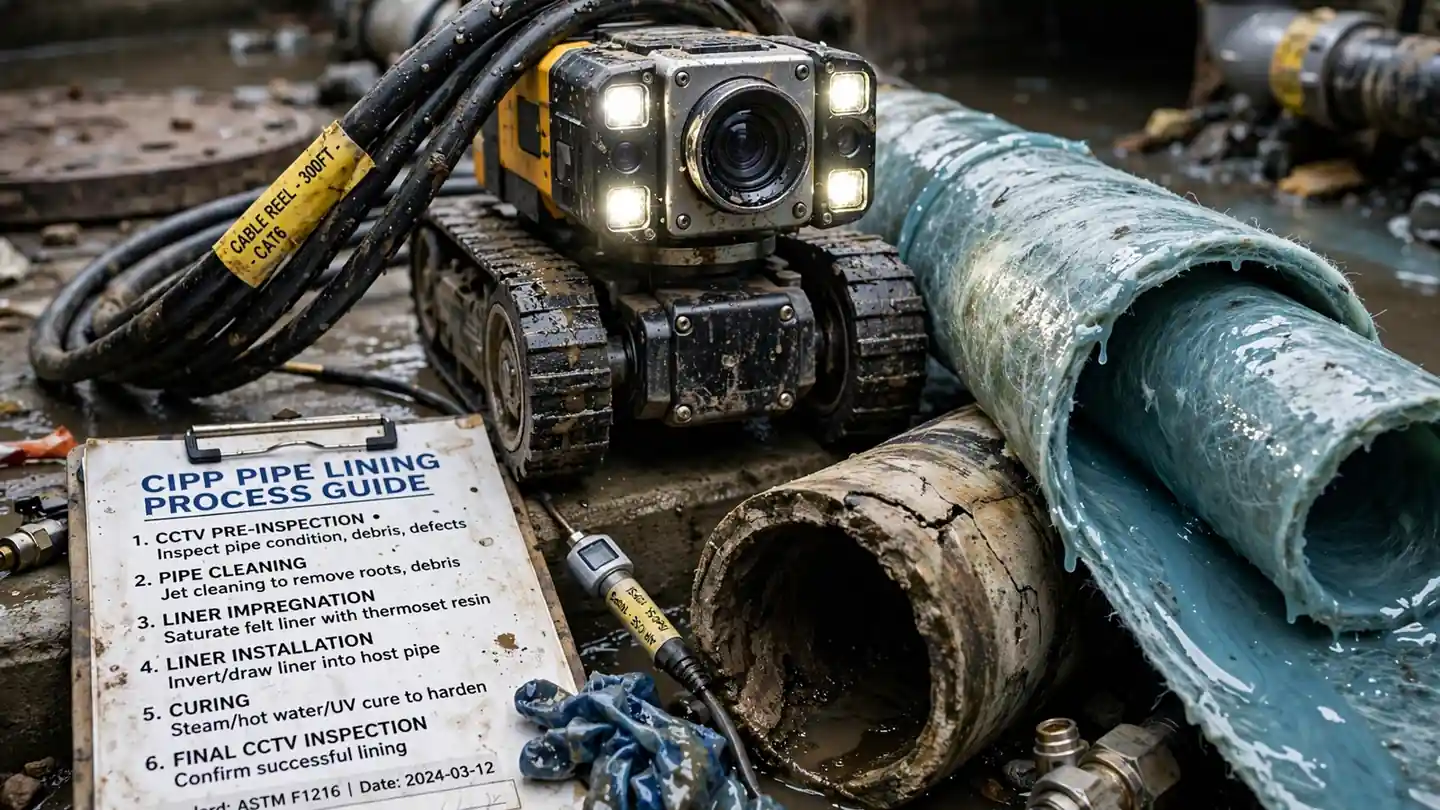
Stage four is curing: heat, steam, or UV light hardens the resin to its structural specification. Curing follows the resin's chemistry, not the clock — rushed cures produce soft spots and failed liners. A professional explains the cure method and timeline; a corner-cutter hurries it.
Stage five is verification, and it is non-negotiable. The cured liner is televised its full length: continuous, jointless, properly seated at both ends, with every branch connection robotically reinstated and flow-tested. You receive this footage — the proof of the invisible work — along with documentation of the installation.
In the Marlborough area, CIPP earns its keep wherever the surface above the pipe is valuable: downtown's tight lots, French Hill's antique streetscapes, the lake neighborhoods where trenches hit groundwater, and farmhouse lanes under stone walls. Our pipe lining page details the method's local applications; our trenchless sewer repair page compares it with bursting.
The candidacy question — can your pipe be lined? — is answered in stage one. Lining needs a host pipe with remaining shape: cracked joints, root entries, and moderate offsets qualify; fully collapsed sections and severe bellies do not. The camera keeps everyone honest, which is why the process starts there and why you should never accept a lining quote without footage.
Resin chemistry deserves a plain-language note: the two-part epoxy saturating the liner is calibrated — resin type, catalyst ratio, and volume matched to your pipe's diameter, length, and defect profile. This calibration is invisible in the finished job and decisive in its lifespan. When vetting contractors, 'what resin system do you use and how is it calibrated' is a question that separates professionals from installers.
Curing methods vary — ambient, hot water, steam, UV — and each suits different situations. UV curing is fastest where the equipment fits; steam and hot water are the workhorses for residential laterals. The method matters less than the discipline: full cure to specification, verified by temperature monitoring or cure-time calculation, not estimated by feel.
The branch reinstatement step is where inexperienced installers fail visibly: every lateral connection — kitchen, baths, laundry — must be robotically reopened after curing, and each verified flowing on the final camera pass. A sealed branch discovered after the crew leaves is a callback that should never have happened; the verification pass exists to prevent it.
FAQ
Questions
Frequently Asked Questions
Most residential liners complete in a day: inspection and prep, then inversion and cure, with verification before sign-off. Bypass pumping keeps your drainage working during the cure. The dispatcher lays out your specific timeline when you call (833) 713-2101.
Two-part epoxy, calibrated to your pipe's diameter and condition — and yes, it matters enormously. Correct resin, correct saturation, correct cure: the three variables that decide whether the liner lasts decades or fails early.
Slightly — the liner wall has thickness. In practice flow usually improves because the smooth epoxy has far less friction than the rough old pipe. Where capacity is marginal, bursting (which can upsize) is discussed as the alternative.
The verification footage: continuous jointless liner, seated ends, reinstated branches, all televised after curing. Plus documentation of resin and cure. No footage, no proof — insist on both.