The package says 'flushable.' The sewer line disagrees. Despite the label, disposable wipes are the single most common foreign object pulled from residential blockages in the Marlborough area — they do not break apart like toilet paper, they snag on every joint and root fiber in the lateral, and they accumulate into dense masses that professional equipment must remove. If wipes go down your toilets, your lateral is living on borrowed time.
The chemistry explains the failure. Toilet paper is engineered to disintegrate in water within seconds; wipes are engineered to stay intact while wet — the exact opposite property. In the lateral, intact wipes drape over offsets, wrap around root intrusions, and felt together into blockages that grow with every flush. A home with wipe-flushing habits can block a lateral that would otherwise flow for decades.
The warning signs are progressive: toilets that need double-flushing, gurgling when the washer drains, then the slow creep of drainage times across the house. By the time sewage appears where it should not, the wipe mass has usually been building for months. A sewer line cleaning visit with camera verification shows the accumulation directly — and the footage is persuasive in a way words are not.
Septic-system homes face an amplified version: wipes do not digest in the tank, they clog the outlet baffle and migrate toward the drain field, where they can damage the most expensive component of the system. Municipal-sewer homes are not safe either — the lateral is the wipe's first and narrowest obstacle.
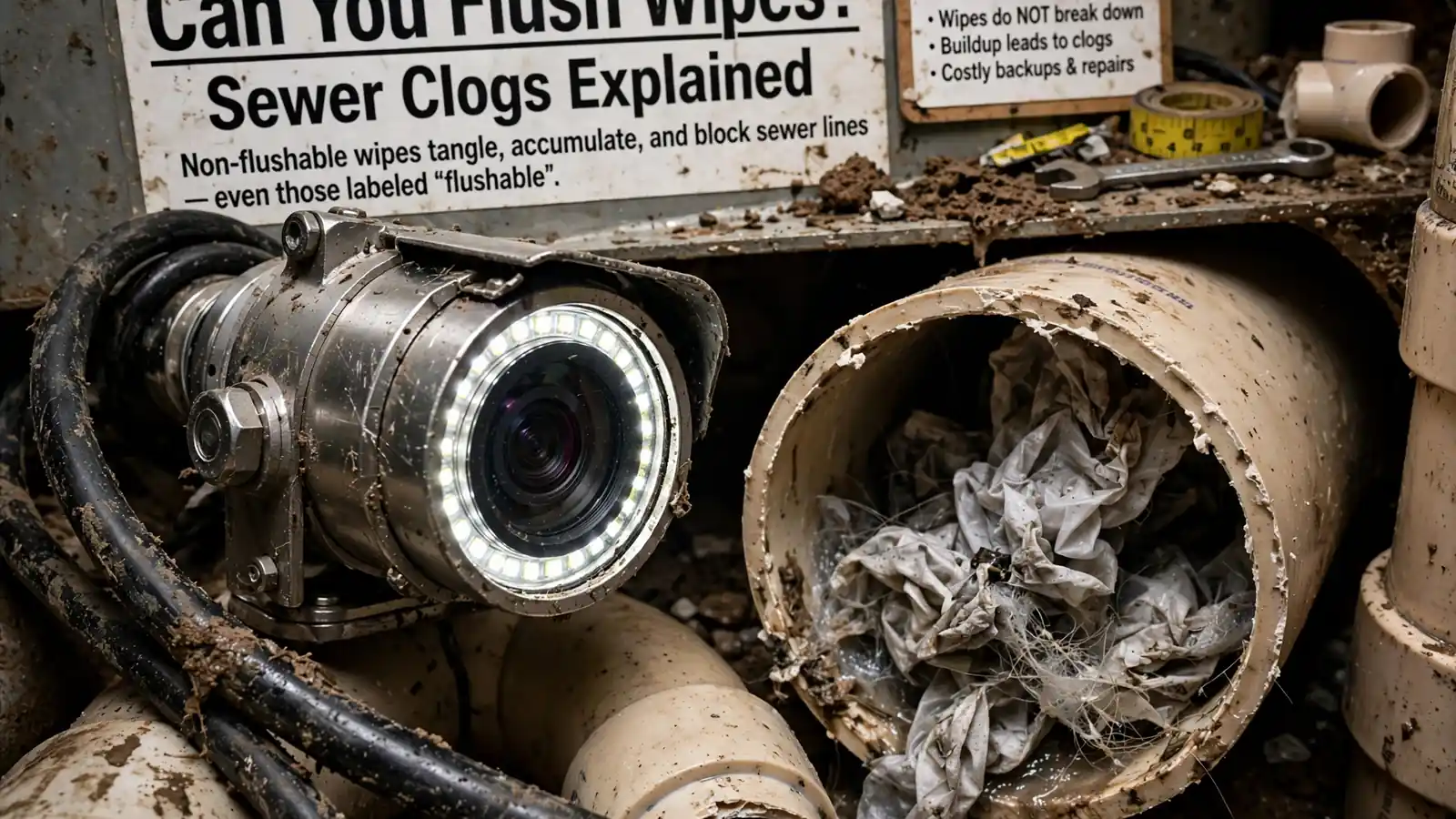
'Biodegradable' on the package does not change the physics. Biodegradation takes weeks in agitated treatment conditions; your lateral gives the wipe hours in still water. The only wipe that belongs in a toilet is toilet paper — everything else belongs in the trash, no matter what the marketing claims.
If the habit is already established, the recovery plan is straightforward: stop flushing wipes immediately, schedule a sewer camera inspection to assess what has accumulated, and have the line professionally cleaned if the footage shows buildup. The camera also reveals whether the wipe masses have been masking structural issues — roots and offsets that the wipes were snagging on.
Households with children or caregivers need a house rule, not a hope: wipes go in the trash, every time, with a lidded bin beside every toilet. Guests follow the visible system — a small sign or a conveniently placed bin does more than any lecture. The lateral cannot tell who flushed the wipe; it only knows the blockage.
The cost comparison is stark: a trash bin versus an emergency emergency sewer repair visit with water damage. Every plumber in MetroWest has a wipe story; none of them end with the wipes winning. Break the habit now, verify the line with a camera, and give your lateral the uneventful life it was designed for.
The municipal side of the wipe problem deserves mention: wipes that clear your lateral intact go on to clog pump stations and treatment equipment downstream, which is why many Massachusetts municipalities have run public-awareness campaigns against them. Your lateral is the first victim, not the only one — the wipe's journey of destruction continues past your property line.
Rental properties and multi-unit buildings need the rule posted, not just practiced: tenants follow the system they see, and a wipe habit in one unit becomes a building-wide lateral problem. Property managers in the Marlborough area increasingly include 'no wipes' in lease language alongside the trash bins that make compliance easy.
If the camera reveals that wipe masses were the only problem — sound pipe underneath — the outcome is the best-case: professional cleaning, the habit broken, and a maintenance interval set from the clean footage. The lateral forgives quickly once the insult stops; it is the continuation that it cannot survive.
FAQ
Questions
Frequently Asked Questions
No wipe currently sold disintegrates like toilet paper in lateral conditions — including those labeled flushable or biodegradable. The wastewater industry's position is consistent: only toilet paper goes down the toilet. Everything else risks the blockage this post describes.
Probably accumulating, not fine. Wipe masses build gradually and the lateral compensates until it cannot — the failure arrives suddenly after years of quiet buildup. A camera inspection shows the real state; call (833) 713-2101 before the sudden part.
No — disposals grind food waste, not wipe fabric, and the ground fragments still felt together downstream. Disposals do not make wipes flushable.
A lidded trash bin beside each toilet. It is the entire solution — simple, complete, and far cheaper than any blockage it prevents.